







Procore reports more than 3 million users, but it does not publish standard pricing. Its fees are tied partly to Annual Construction Volume, meaning costs can rise with the value of work delivered rather than the number of people actively using the platform. Third-party estimates range from roughly $4,500 to more than $200,000 per year, which makes any single price figure unreliable.
This guide compares eight alternatives by pricing, contractor type, workflow fit, and recurring user sentiment. We do not sell a competing platform, so the recommendations are based on buyer fit rather than product promotion, and the first two sections argue you may not need to switch at all.
TL;DR: Best Procore Alternatives in 2026
- Design and BIM coordination Autodesk Forma Build
- Residential client communication Buildertrend
- Small contractors on a budget Contractor Foreman
- Field execution and drawings Fieldwire by Hilti
- Commercial GC contract controls RedTeam Flex
- A price you can budget against ConstructionOnline
- Flat cost as headcount grows Projul
- Scheduling and portfolio depth Oracle Primavera P6
Procore Alternatives at a Glance
| Alternative | Best for | Pricing model | Published price? | Main trade-off |
|---|---|---|---|---|
| Autodesk Forma Build | Design and BIM coordination | Per seat | Yes | No free subcontractor seat |
| Buildertrend | Residential client communication | Quote, revenue-based | No, as of Aug 2026 | Weak for commercial hard bids |
| Contractor Foreman | Small contractors on a budget | Published tiers | Yes | Setup curve, thin estimating data |
| Fieldwire by Hilti | Field execution and drawings | Per seat, free tier | Yes | Partial replacement, no financials |
| RedTeam Flex | Commercial GC contract controls | Quote | No | Longer implementation |
| ConstructionOnline | A price you can budget against | Published starting price | Yes | Less familiar to new hires |
| Projul | Flat cost as headcount grows | Flat annual tiers | Yes | Annual commitment, no monthly plan |
| Oracle Primavera P6 | Scheduling and portfolio depth | Quote | No | Partial replacement, no document control |
Why Do Construction Companies Leave Procore, and Should You?
Construction companies usually consider leaving Procore because of cost, poor fit, or weak field adoption. But switching only makes sense when the software itself is the problem. If the real issue is unused modules, poor onboarding, or inconsistent workflows, another platform may simply recreate it.
A 2023 r/ConstructionManagers thread captures this. A mid-sized contractor wanted something simpler because the team mainly used Procore for daily logs, RFIs, drawings, punch lists, and communication. A year later, the poster said they were still using Procore because the move felt too risky.
Cost
Procore's fee is indexed to Annual Construction Volume, so the bill tracks revenue rather than usage. Third-party estimates for 2026 run from roughly $4,500 to over $200,000 a year, and that spread is the finding. One New York practitioner described the cost as a 3 percent fee and judged it worth paying, while published analyses put the rate nearer 0.1 to 0.2 percent of volume.
Company and Industry Fit
Unlimited users and storage are real advantages, and also why the platform feels heavy to a ten-person team running four jobs. Procore is built around commercial project workflows, so residential builders and service trades are often shopping in the wrong category rather than for a better product.
Field Adoption
Procore displays its own app-store ratings on its pricing page: 4.6 on Apple's App Store across roughly 45,000 ratings, 3.7 on Google Play across roughly 3,200. Android is the dominant handset on plenty of jobsites, so run your trial on the device your superintendents carry.
Across all three, cost, fit, and field adoption, low utilisation is usually an onboarding and permissions problem wearing a software costume. Before scoping a migration we check who holds licences, who logs in weekly, and which workflows still run over text message. If three of five workflows never entered the system, switching platforms moves the problem instead of solving it.
Choose an Alternative Based on Why Procore Is Not Working
If you have decided the software really is the problem, start from the reason you are leaving, not from a feature grid. Each reason points to a different shortlist, and each shortlist has a trade-off you accept going in.
| Reason for leaving | What to prioritise | Best-matched alternatives | Trade-off |
|---|---|---|---|
| Cost is unpredictable | Published, non-volume pricing | Contractor Foreman, ConstructionOnline, Projul | Smaller integration ecosystems |
| Field crews will not use it | Mobile-first, offline plans | Fieldwire | Not a full replacement |
| Scheduling is not deep enough | Critical path, resource optimisation | Oracle Primavera P6 | Needs a document system alongside |
| Accounting is the whole problem | Construction ERP, not a PM tool | CMiC, Acumatica, Sage, Trimble Viewpoint | Longer implementations |
| No product fits the workflow | Integration or custom development | Extend, integrate, or build | Needs engineering ownership |
If you dispatch service calls rather than run projects, you are in the wrong category: ServiceTitan, JobNimbus, and Jobber serve trades, not project management. Owner-side teams should look at capital-programme tools such as Mastt.
How We Evaluated These Alternatives
Products were selected on search demand, AI Overview presence, segment relevance, and whether enough reliable public information exists to be useful. Products without enough public evidence to assess fairly were left out rather than included to reach a round number.
Features come from official product pages. Pricing comes from vendor pricing pages where published, with the verification date stated. Where a review base is thin, RedTeam Flex and Projul both sit on small samples, we flag it beside the evidence rather than presenting it as settled. This is a public-evidence comparison, not a hands-on test of all eight.
What Are the Best Procore Alternatives in 2026?
The best Procore alternatives are Autodesk Forma Build, Buildertrend, Contractor Foreman, Fieldwire, RedTeam Flex, ConstructionOnline, Projul, and Oracle Primavera. They are not interchangeable, the right choice depends on your contractor type, company size, budget, and the workflows you need to replace.
Autodesk Forma Build
Best for design and BIM coordination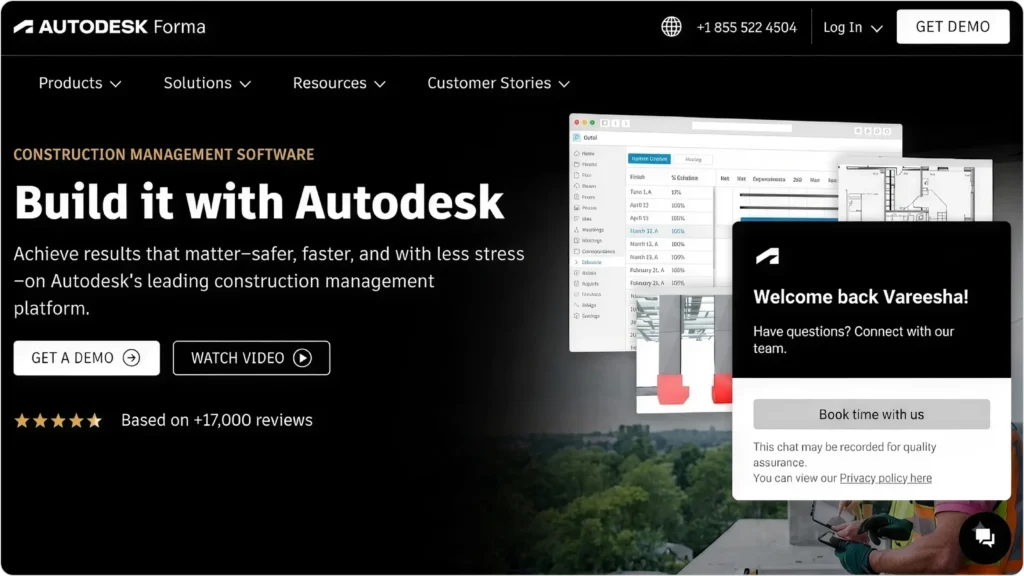
Published per-user plans, with quote-based unlimited-user pricing. Estimating and takeoff are separate Forma products.
Connects drawings, models, field execution, cost management, and project controls. Autodesk Build became Forma Build on March 24, 2026.
Buildertrend
Best for residential builders and remodelers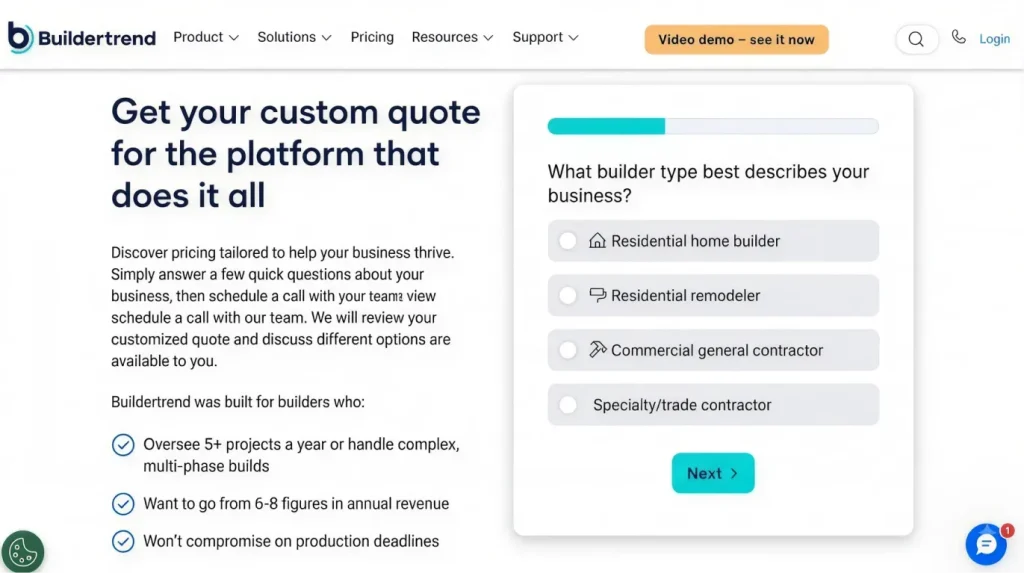
Custom quote based on details such as builder type and annual construction volume. Unlimited users and projects are included.
Residential workflows include selections, warranties, takeoff, scheduling, and a homeowner-facing client portal.
Contractor Foreman
Best for small contractors on a budget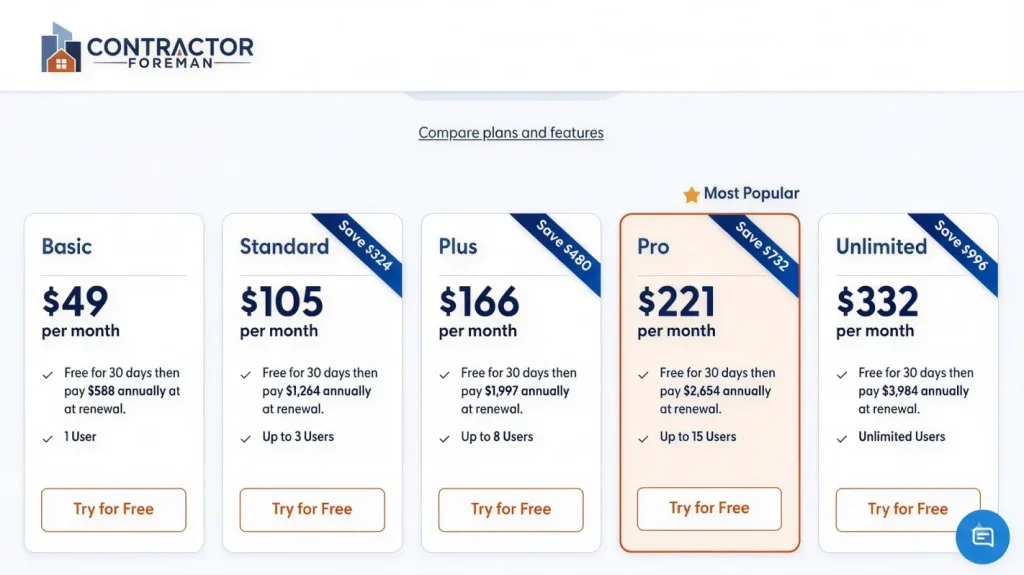
Starts at $49 per month with annual or quarterly billing. Plans support 3, 8, 15, or unlimited internal users.
Provides estimating, scheduling, invoicing, time tracking, and project management at a lower entry price.
Fieldwire by Hilti
Best for field execution (partial replacement)
Free for five users. Paid annual plans cost $39, $64, or $89 per user per month.
Strong plan viewing, markups, task management, and offline field access. Budgets, RFIs, submittals, and change orders require Business Plus.
RedTeam Flex
Best for commercial GC contract controls
Custom pricing based on Active Project Value. Monthly billing and unlimited users, projects, storage, and collaborators are available. Integrations cost extra.
Covers contracts, job costing, WIP reporting, lien waivers, billing, RFIs, and submittals.
ConstructionOnline
Best for segment-specific published pricing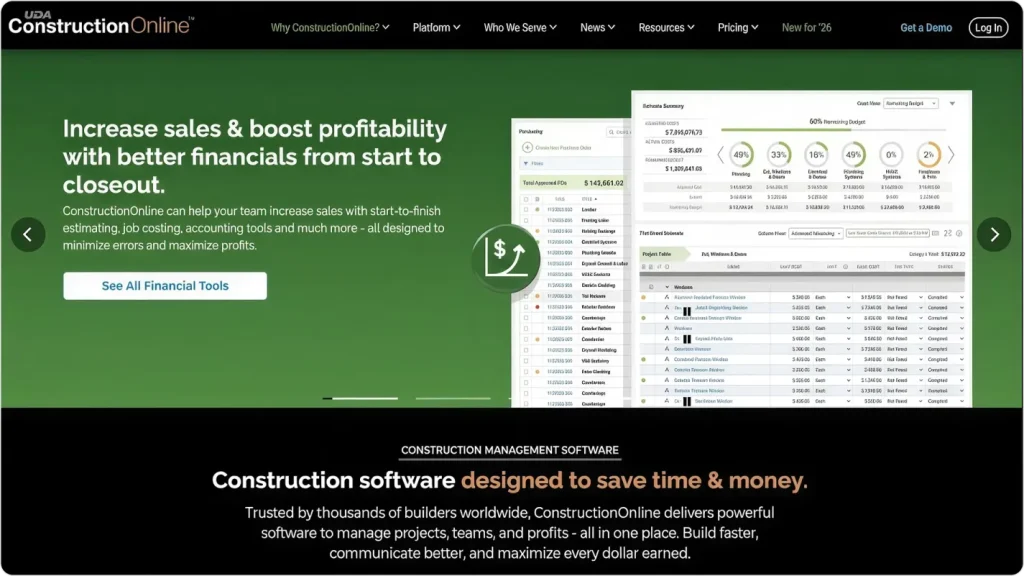
Separate published plans for residential, commercial, specialty, multifamily, and other segments. Residential Professional costs $475 monthly, or about $396 per month with annual billing.
Combines estimating, scheduling, job costing, portals, RFIs, and submittals with unlimited users on published plans.
Projul
Best for flat cost as headcount grows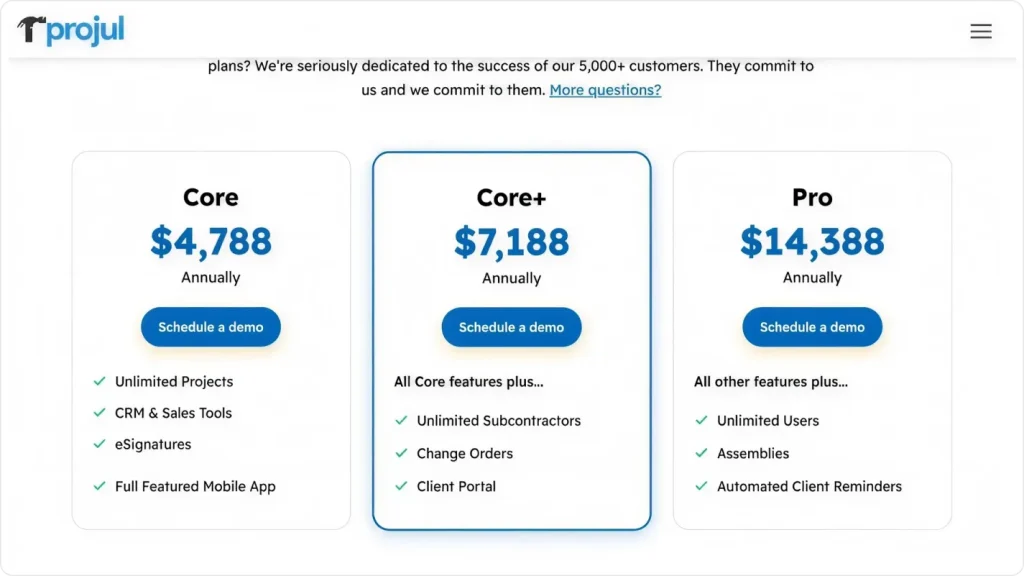
Annual plans cost $4,788, $7,188, and $14,388. All have unlimited projects and no per-user charges; the Pro plan explicitly includes unlimited users.
Combines CRM, estimating, scheduling, invoicing, and project management under annual flat-rate plans.
Primavera P6 EPPM
Best for portfolio and CPM scheduling (partial replacement)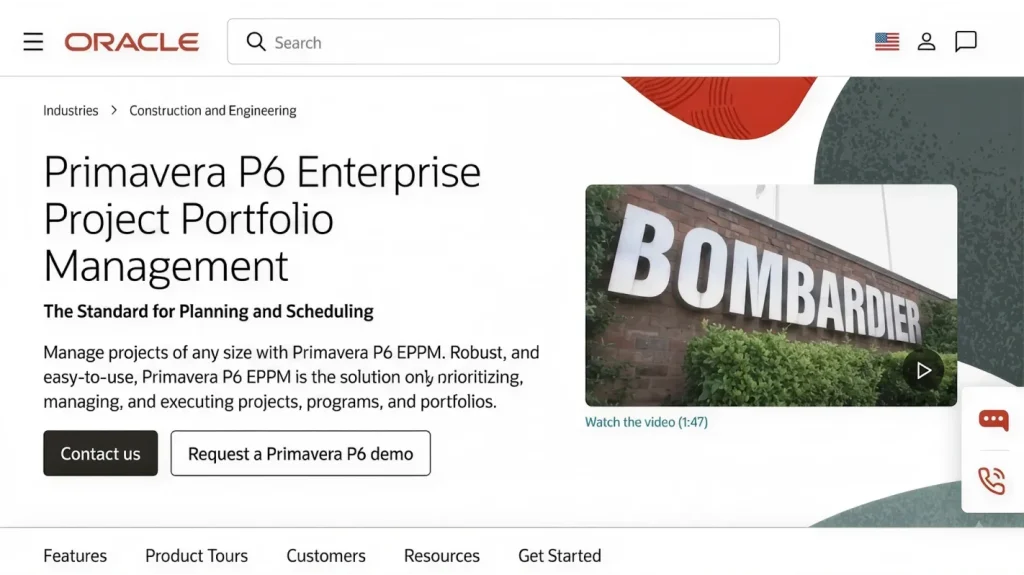
Oracle does not publish simple standard pricing; licensing requires a quote.
Provides CPM scheduling, resource levelling, earned-value tracking, and cross-project portfolio controls. P6 EPPM and Oracle Primavera Cloud are separate products; neither is a complete Procore replacement.
Procore Versus the Three Most-Compared Alternatives
Procore is the broader construction management platform, while Autodesk Forma Build, Buildertrend, and Fieldwire each outperform it in narrower workflows. Forma Build is strongest for BIM-led delivery, Buildertrend for residential construction, and Fieldwire for field execution.
Forma Build wins on model coordination, drawing version control, and Revit integration, and it publishes per-seat pricing. Procore includes unlimited users covering subcontractors and clients at no extra seat cost, where Forma Build charges per licence with no free viewer seat and sells estimating separately.
Buildertrend treats selections, warranties, and homeowner communication as first-class workflows; Procore is built for commercial multi-prime administration. Both now quote against revenue or builder type, so Buildertrend is no longer the transparent-pricing option. Choose by work type, not price.
Fieldwire is a field tool with a free tier and the strongest offline story; Procore is a full system of record. Fieldwire tracks budgets and change-order costs from Business Plus but has no invoicing or native accounting sync. Choose Fieldwire if crews will not open the current system and the money already has somewhere to live.
Comparing a shortlist against a Procore quote?
Send us the two or three you are weighing and the workflows you actually run. We will tell you where each one leaves a gap you would have to integrate or build around. An engineering read, not a sales pitch.
Which Procore Alternative Fits Your Contractor Type?
The best Procore alternative depends on your contractor type, project size, and core workflow. Where the reason-for-leaving table and this one disagree, the contractor type usually wins.
| Contractor type | Start with | Why |
|---|---|---|
| Small contractor under $10M | Contractor Foreman | Published tiers, unlimited sub access |
| Residential builder or remodeler | Buildertrend, Projul | Selections, warranties, client portal |
| Mid-market general contractor | RedTeam Flex, ConstructionOnline | Contract and cost controls, forecastable pricing |
| Commercial GC, BIM-heavy | Autodesk Forma Build | Model coordination and drawing control |
| Subcontractor or specialty trade | Fieldwire, Contractor Foreman | Field-first, low seat cost |
| Enterprise contractor | Autodesk Forma Build, construction ERP | Scale, administration, accounting at the centre |
| Infrastructure or owner-side | Primavera P6 EPPM plus a document platform | Portfolio scheduling |
What Do Construction Teams Say About These Alternatives?
The patterns below come from published review data and one community thread. Evidence confidence reads as how much public data stands behind the pattern, not as a quality score for the product.
| Alternative | Most praised | Most criticised | Evidence confidence |
|---|---|---|---|
| Autodesk Forma | Drawing and model control, near-parity by 2026 | Per-licence cost, dated dashboard | High |
| Buildertrend | Client portal, unlimited users | Renewal escalation, weak commercial estimating | Medium to high |
| Contractor Foreman | Price-to-feature ratio | Setup curve, thin estimating database | High |
| Fieldwire | Drawing markup, offline tablet use | RFI workflow, per-seat growth | High |
| RedTeam Flex | Support responsiveness | Implementation time, ease of use | Medium evidence limited |
| ConstructionOnline | Customer service, 4.8 across 596 reviews | Lower market recognition | Medium to high |
| Projul | Flat, predictable cost | Annual commitment; one onboarding complaint, refunded, a single anecdote | Medium |
| Oracle Primavera | Scheduling depth | Learning curve, dated interface | Medium to high |
Patterns below come from published review data and one r/ConstructionManagers thread of 39 comments spanning August 2023 to August 2026.
How Much Do Procore Alternatives Cost?
Procore alternatives range from free to $14K+ a year. Fieldwire is free, with paid plans from $39/user/month; Contractor Foreman $49/month; ConstructionOnline $475/month; RedTeam Flex $729/month; Projul $4,788/year; Autodesk Forma Build about $117/user/month; and Procore, Buildertrend, and Oracle Primavera are custom quote. The pricing model matters more than the headline rate, because it decides how the cost behaves as you grow.
Volume-indexed, quote only
Procore, Buildertrend
Cost grows with revenue, whether or not usage changesPer seat, published
Autodesk Forma, Fieldwire
Cost grows with headcountFlat tiers, published
Contractor Foreman, ConstructionOnline, Projul
Cost grows with tier upgrades onlyEnterprise quote
RedTeam Flex, Oracle Primavera, ERP platforms
Cost grows with negotiated scopeSubscription is not total cost. Budget for implementation, data migration, separate office and field training, a takeoff tool if the estimating module is thin, integration work where no native connector exists, and the overhead of running two tools instead of one. The full picture is on the construction management software cost page.
What Should You Check Before Switching From Procore?
Check what your data looks like on the way out before you evaluate anything else. This is the step teams skip, and the reason migrations stall.
Per Procore's own support documentation, the Procore Extracts application exports project data as a folder structure in which most items download as PDFs, while documents and photos keep their original file types. Extracted submittals omit spec section numbers if the relevant company setting is off. Only projects set to Active can be extracted, so archived jobs must be reactivated first. Procore Analytics 1.0, which included a SQL-based archive, lost technical support on 31 December 2025 and access on 30 June 2026.
A working list to read against your own situation before you commit to a switch.
- Which records you need as structured data rather than PDFs, including drawing revision history, custom fields, and permissions
- Financial continuity: budgets, change orders, commitments, pay applications
- Open RFIs and submittals at cutover, and who owns them during the gap
- Every integration Procore handles now, and its replacement
- Subcontractor re-onboarding, often the largest hidden effort
- A parallel run on at least one live project
- Contract notice periods and renewal dates, which set your real timeline
Should You Replace Procore, Extend It, or Build Something Custom?
Most companies should buy or extend. Buy when a product matches 80 percent or more of your workflow. Combine tools when two workflows dominate and someone owns reconciliation between them.
Extend when the gap is one workflow and the API reaches the data. Build custom software only when the workflow itself is the competitive advantage, usually a proprietary process, manual workarounds running over a year, or licence costs scaling disproportionately against value. Our full framework, including where no-code and AI app builders fit, is in build versus buy for construction software.
Planning a switch away from Procore?
The platform decision is the easy half. The data extract, the parallel run, and the integrations that Procore handles today are what decide whether the move works. A 30-minute call will tell you where your real migration risk sits before you give notice.
Frequently Asked Questions
Yes. Contractor Foreman publishes annual tiers reported to start at $49 per month, and Fieldwire offers a free plan. Because Procore prices on annual construction volume and publishes nothing, the comparison depends on your revenue. Get a Procore quote first so you are comparing real numbers.
No. Procore has no free tier and its pricing page routes all buyers to a custom quote, verified 5 August 2026. Fieldwire Basic is the only permanent free plan among established construction management platforms, capped at five users and three projects. Free offers elsewhere are trials.
Harder than teams expect, because of data format rather than training. Procore's documentation confirms most exported items arrive as PDFs, only Active projects can be extracted, and its Analytics 1.0 archive lost access on 30 June 2026. Plan a parallel run on one live project and decide early which records you need as structured data.
Autodesk Forma Build is the closest competitor on feature breadth for commercial contractors, and Buildertrend is the strongest in residential. Neither is a universal replacement, because Procore's unlimited-user model and contract administration remain hard to match.
Software like Procore includes Autodesk Forma Build, Buildertrend, Contractor Foreman, RedTeam Flex, ConstructionOnline, and Projul as full platforms, plus Fieldwire for field execution and Primavera P6 EPPM for scheduling. If you dispatch service calls rather than run projects, you want field service software or a construction CRM such as ServiceTitan or JobNimbus, not a project management platform.