Build and Scale Faster
150+ products shipped for startups and enterprises by engineers focused on real outcomes.
"Their ability to quickly understand an unfamiliar use case and respond creatively to it is impressive."

Anonymous
Executive, Pured Disc Golf

"TechnBrains resolved challenges efficiently and turned my vision into a solid, functional product with a strong foundation."

Jalen Gibbs
Founder, STREAMLINE LIVE
"The talent they provided was solid, but more importantly, they were quick to align with our way of working."

Nancy Snyder
Managing Director, MimeCast
Our trusted clients


Start Your Product Journey Today
Turn your idea into a working product. Share a few details and we'll help define the roadmap, timeline, and execution approach.
Best Real Estate Software in 2026: CRM, Investment and Property Management Tools
The best real estate software in 2026 depends on the category. Wise Agent ($49/month flat) wins for small-team CRM, PropStream ($99/month) for finding deals, AppFolio for portfolios above 200 units, Buildium (from $62/month) below that, and Realtyzam ($14/month) for agent accounting. Here are 20 tools compared, plus when to build custom.

Updated Aug 10, 2026
A third of Realtors spend $50 to $250 a month on technology, and two-thirds say their brokerage already gives them every tool they need, according to NAR’s 2025 Technology Survey.
Both are true, because that budget rarely buys one system. It buys four or five: something for leads, something for transactions, something for the books, something for investor reporting, and a spreadsheet holding the gaps together.
This guide covers the best real estate software in 2026 by category, what each tool costs, and where buying software stops being the right answer and real estate app development becomes the cheaper option.
Already know no tool on this list fits your workflow?
Skip to when to build custom, or talk to our PropTech team about scoping a build.
Talk to a Proptech ExpertHow Did We Evaluate the Best Real Estate Software?
This is a public-evidence evaluation, not a hands-on test. We scored each tool on three lenses:
- Workflow fit (does it solve the whole job or one slice),
- Adoption burden (migration, onboarding fees, contract terms, minimum spends), and
- Evidence confidence (how much of the verdict rests on independent reviews and vendor documentation versus vendor claims or thin data).
Where this read comes from. We build PropTech products rather than resell software, so we have not run these platforms as a paying customer and do not claim to have. We have built the systems operators move to when a platform stops fitting, including scheduling and dispatch platforms serving 685,000+ users.
In those projects, the expensive surprises sat at the boundaries: what a system exports, what its API exposes at which tier, and how a lease or a fee split is modelled underneath. Reviews rarely cover that.
Every price was checked against the vendor’s own pricing page in August 2026. Where a vendor does not publish pricing, the figure is labelled a third-party estimate. Where sources disagree, we say so instead of picking the most quotable number.
Four adjacent categories were excluded on purpose: mortgage origination platforms, which serve a different buyer; generic horizontal CRMs, which lack real estate data models; general contractor construction management suites, which sit on the builder side of the table rather than the owner side and are covered separately in our construction software work; and fund administration outsourcing, which is a service rather than software.
What is the Best Real Estate CRM Software in 2026?
Wise Agent is the best real estate CRM software for solo agents and small teams because of flat pricing, and Follow Up Boss is the best for growing teams because of lead routing depth. HubSpot’s free tier is the strongest entry point for anyone who wants free real estate CRM software before committing budget.
| CRM | Best for | Published price | Sentiment | Evidence confidence |
| Wise Agent | Solo agents, small teams | $49/mo flat, up to 5 shared users | Generally positive | High |
| Follow Up Boss | Growing teams, high lead volume | $69/user/mo (Grow); $499/mo for 10 users (Pro) | Positive with recurring concerns | High |
| HubSpot CRM | Free entry point | Free tier; paid tiers scale | Generally positive | Medium |
| Lofty (formerly Chime) | Teams that want AI follow-up plus IDX | Quote only; reported from $449/mo plus setup | Mixed | Medium |
1. Wise Agent (Best for Solo Agents and Small Teams)
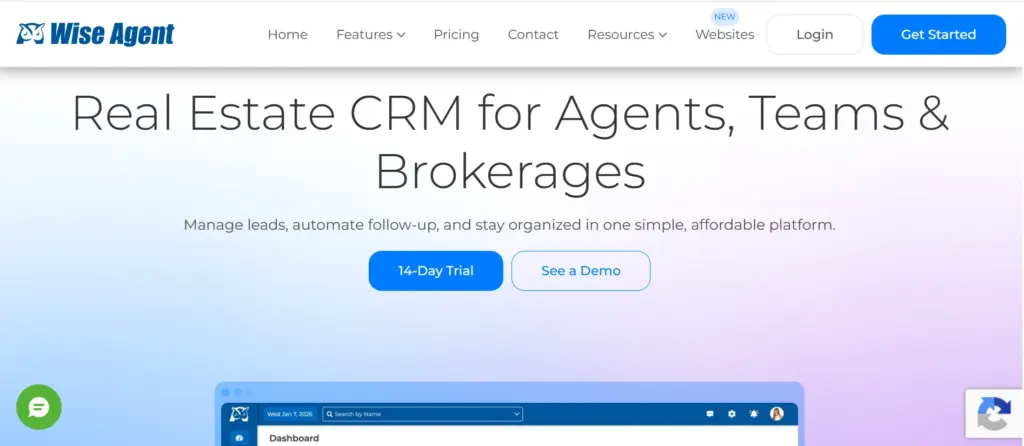
Wise Agent charges per account, not per seat. The CRM plan is $49/month or $499/year, covers up to five team members on a shared login, and includes 24/7 support. Individual logins are $20/month and SMS is $11/month plus an $80 one-time registration fee.
Choose it if you want predictable cost and you can live with a shared login. Skip it if each agent needs their own permissions and reporting, because the add-on logins erode the price advantage quickly.
2. Follow Up Boss (Best for Growing Teams)
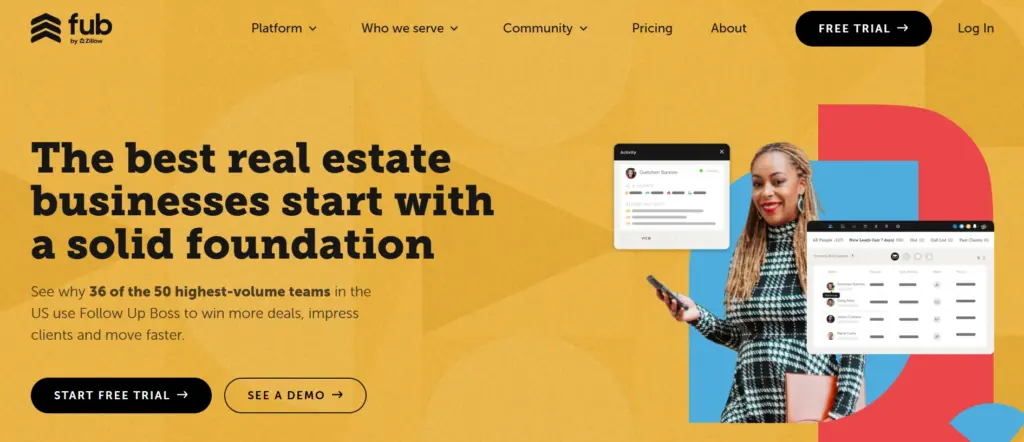
Follow Up Boss is built around lead speed rather than database management, and the routing, assignment, and response-time reporting are what teams pay for. Grow is $69 per user per month, Pro is $499 per month for up to 10 users, and Platform is $1,000 for up to 30. Calling is a $39 per user add-on, the line item most buyers miss.
Ownership note: Follow Up Boss was acquired by Zillow in late 2023 and still operates as a standalone product. If your lead sources include Zillow competitors, ask directly about data segregation before you migrate a database into it.
3. HubSpot CRM (Best free Real Estate CRM Software)
HubSpot is not real estate specific, and that is the tradeoff. There is no MLS or IDX integration out of the box. In exchange, the free tier is a real product rather than a trial, and the upgrade path does not require a migration.
4. Lofty (Best for AI-assisted Follow-up)

Lofty rebranded from Chime in November 2023 and bundles CRM, IDX website, lead generation, and an agentic follow-up layer that engages leads across chat, SMS, and email. All four plan tiers are request-pricing on the vendor’s site.
Third-party trackers report a starting point around $449/month plus a setup fee, and reviews describe strong AI follow-up alongside real configuration effort. Our breakdown of AI in real estate covers where this holds up and where it does not.
The CRM that is no longer on the list
Lone Wolf Technologies acquired LionDesk in 2021 and shut it down at the end of September 2025, migrating users to a product called Lone Wolf Relationships. New signups are not possible. Lone Wolf’s CEO attributed the decision to scalability and technical limitations rather than demand.
Why it matters: the shutdown is the clearest illustration of platform risk in this category. LionDesk did not fail commercially. It failed to fit an acquirer’s roadmap, and thousands of agents rebuilt their follow-up systems as a result.
Similarly, kvCORE is now BoldTrail. Inside Real Estate unified kvCORE, BoomTown, and Brokermint under that brand in mid-2024, so a kvCORE review is a review of a product name retired two years ago.
What is the Best Real Estate Investment Software for Investors?
PropStream is the best real estate investment software for finding deals, and AppFolio Investment Manager is the best for managing investor capital and reporting. They solve different problems, and most active sponsors run one of each.
| Tool | Best for | Published price | Sentiment | Evidence confidence |
| PropStream | Deal sourcing, skip tracing, off-market lists | $99/mo (Essentials), $199 (Pro), $699 (Elite) | Generally positive | High |
| AppFolio Investment Manager | Investor capital and reporting | Reported from $650/mo (Core); Premier custom | Positive with recurring concerns | Medium |
| InvestNext | Growing sponsors needing all-in-one | From $499/mo, annual commitment | Mixed | Medium |
| DealMachine | Driving for dollars, mobile lead capture | Tiered subscription; verify live | Limited evidence | Limited |
1. PropStream (Best for Finding Deals)
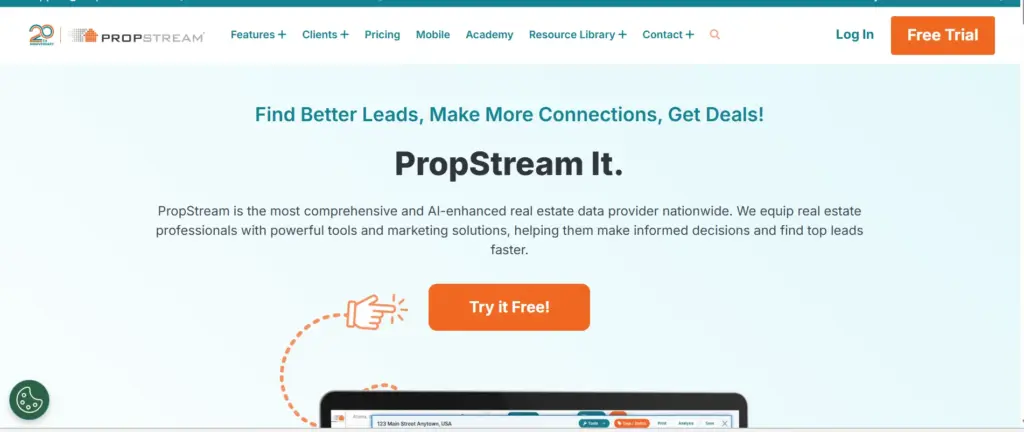
PropStream is a property data platform first: roughly 160 million US property records, filters for equity, foreclosure status, tax delinquency, and ownership type, plus comps and direct mail. Essentials is $99/month or $81/month billed annually, Pro is $199, and Elite is $699.
The subscription is not the cost. Skip tracing runs about $0.12 per contact and is not included at the entry tier. Tracing 500 records a month adds $60 to $75 before any dialer or CRM. Budget the workflow, not the plan.
2. AppFolio Investment Manager (Best for Managing Investor Capital)

Investment Manager is the capital-side product: investor portal, fundraising workflows, distributions,, with API access, Zapier, and SQL export reserved for Premier. AppFolio does not publish this pricing. Third-party analyses report Core from around $650 per month, with Premier quoted against portfolio complexity and user count.
3. InvestNext (Best Value for Growing Sponsors)

InvestNext prices from $499 per month on a 12-month commitment, scaled to funds under management, and includes the investor portal, CRM, fundraising automation, distributions, and reporting. KYC/AML verification, accreditation letters, and ACH processing are typically add-ons.

Failure signal worth reading before you sign: the most detailed negative reviews are about price changes, not product gaps. One Capterra reviewer documented a quarterly bill moving from $775 to $1,647, a 113% increase, with no change in the platform. Get price-escalation terms in writing.
4. DealMachine (Best for Off-market Lead Generation on Foot)
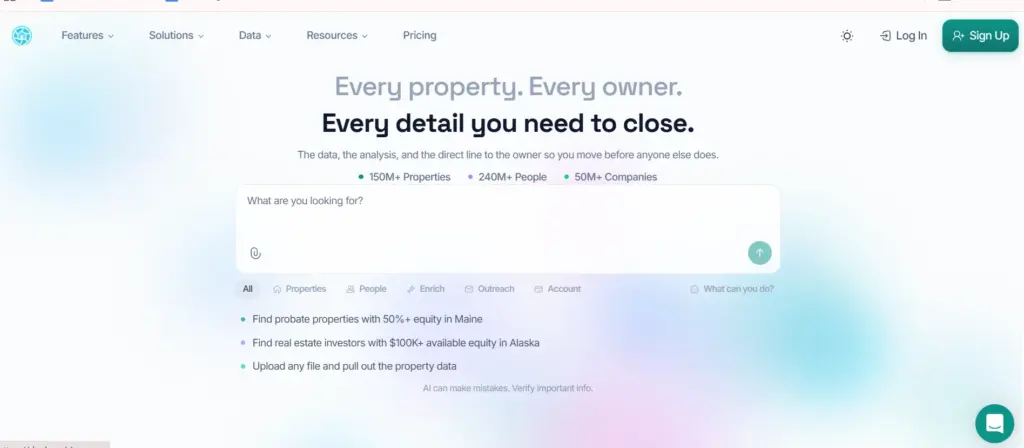
DealMachine is the mobile-first option for driving for dollars: photograph a distressed property, pull the owner record, and push it into a mail or call sequence.
What is the Best Property Management Software for Real Estate?
AppFolio is the best property management software for portfolios above roughly 200 units, Buildium is the best for small-to-mid landlords, and TurboTenant is the strongest free option for self-managing landlords now that TenantCloud has retired its free plan.
| Tool | Best for | Published price | Sentiment | Evidence confidence |
| AppFolio Property Manager | 200+ unit portfolios | Per unit per month with a monthly minimum; see note | Positive with recurring concerns | Medium |
| Buildium | Small-to-mid portfolios | $62/mo (Essential, 150-unit cap), $192 (Growth), $400 (Premium) | Generally positive | High |
| TurboTenant | Self-managing landlords | Free tier; Essentials from $149/yr, Pro from $199/yr | Generally positive | High |
1. AppFolio Property Manager (Best for Mid-to-large Portfolios)

AppFolio has the strongest feature set in residential property management: AI leasing assistant, maintenance workflows, tenant screening, and vacancy marketing in one system. It is also the clearest example of why a headline per-unit rate is not a price.
AppFolio does not publish pricing. Third-party trackers report Core between $1.40 and $1.49 per unit per month against a monthly minimum between $280 and $298. What they agree on is the structure: the minimum is the price until you cross roughly 200 units. A 50-unit operator on Core pays the floor, near $5.96 per unit, about four times the advertised rate.
Choose it if you are above 200 units and the leasing automation replaces headcount. Skip it if you are below 150 units, because you are subsidising a price band you are not in.
2. Buildium (Best for Small-to-mid Landlords)
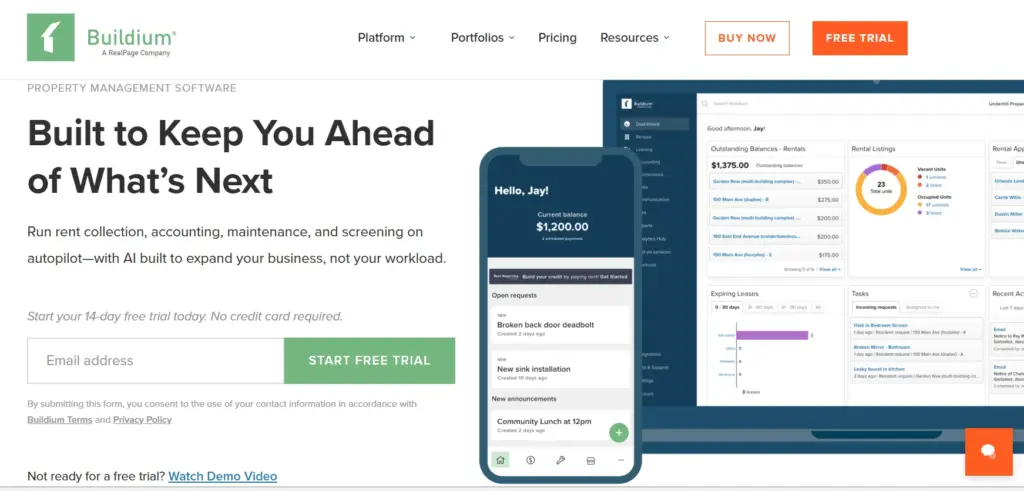
Buildium moved to flat monthly tiers: Essential at $62 with a 150-unit cap, Growth at $192, and Premium at $400, with a 10% annual discount and no per-unit charge.
The base subscription is not the total. Incoming EFT fees run $2.35 per transaction on Essential, $1.35 on Growth, and $0.60 on Premium, cards carry 2.99%. For a portfolio collecting most rent electronically, the tier that looks expensive on the pricing page is often cheaper in total.
Ownership note: Buildium has been a RealPage company since 2019. Operators have publicly reported repeated price and fee increases across that period. Flat-rate pricing is not the same as stable pricing.
3. TurboTenant (Best Free option for Self-managing Landlords)

TurboTenant’s free tier covers listing syndication, screening, applications, messaging, rent collection, and maintenance, with no unit cap and no credit card. Paid tiers are annual: Essentials from $149 per year and Pro from $199 per year, both scaled by portfolio size.
The real read on “free”: the landlord does not pay, but somebody does. On the free plan an applicant pays $55 to be screened, versus $45 under a paid landlord plan, and tenants pay $2 per ACH payment or 3.49% by card. That is a fair trade for a small portfolio, and worth knowing before you tell a tenant the software is free.
What is the Best Commercial Real Estate Software?
Yardi Voyager is the enterprise standard for full-lifecycle commercial real estate management software, MRI Software is the stronger choice for flexible lease accounting, and CoStar is the market data layer rather than an operating system. All three are quote-based.
| Tool | Best for | Pricing | Sentiment | Evidence confidence |
| Yardi Voyager | Large mixed portfolios, one vendor for accounting and leasing | Quote only; enterprise deployments reported in six figures annually | Positive with recurring concerns | Medium |
| MRI Software | Lease accounting, IFRS 16 and ASC 842 compliance, asset modelling | Quote only; modular | Generally positive | Medium |
| CoStar | Market data, comparables, tenant prospecting | Quote only; licensed separately | Generally positive | Medium |
Commercial and residential tools are not interchangeable, and the reason is structural. Commercial leases carry CAM reconciliations, percentage rent, escalation clauses, and bespoke per-tenant terms.
Running a commercial portfolio on residential software means keeping the real lease terms in a spreadsheet beside the software, which is where reconciliation errors start. Our guide to what goes into a commercial real estate app covers the modules that matter first.
Yardi prices against property type, unit count, deployment model, and module selection, so two buyers of the same size can receive very different quotes.
What is the Best Real Estate Accounting Software?
Realtyzam is the best real estate accounting software for agents tracking commissions, QuickBooks Online with a real estate chart of accounts is the most flexible for investors holding property across multiple entities, and Stessa is the simplest option for per-property rental tracking.
| Tool | Best for | Published price | Sentiment | Evidence confidence |
| Realtyzam | Agents tracking commissions, splits, and mileage | $14/mo, or $12/mo billed annually, 30-day trial | Generally positive | High |
| QuickBooks Online + RE chart of accounts | Investors with multiple entities | Standard QuickBooks tiers | Generally positive | Medium |
| Stessa | Per-property rental income and expense tracking | Free Essentials tier; paid tiers from $15/mo | Positive with recurring concerns | Medium |
Realtyzam is deliberately narrow. It logs deals, commissions, splits, mileage, and receipts and produces the reports an agent needs at tax time, without a general ledger to configure. Support is ticket-based only, which is the recurring complaint.
QuickBooks wins for investors for one reason: entity structure. Once a portfolio sits in several LLCs with intercompany transfers, accounting software for real estate investors has to handle a real chart of accounts and inter-entity journal entries. Purpose-built landlord tools generally do not.
Stessa syncs bank accounts, categorises transactions per property, and produces income statements, net cash flow, and Schedule of Real Estate Owned reports. It is owned by Roofstock. The recurring complaints are bank-connection reliability and support responsiveness, so test both on the free tier first.
What is the Best Real Estate Marketing Software?
ActivePipe is the best real estate email marketing software for database nurture, BombBomb is the best for video-led outreach, and BoldTrail is the option to evaluate if you want marketing bundled with CRM and IDX rather than bought separately.
| Tool | Best for | Published price | Sentiment | Evidence confidence |
| ActivePipe (MoxiWorks) | Automated database nurture for agents and brokerages | Quote only | Generally positive | Medium |
| BombBomb | Video email for agents | $42/user/mo, or $36 billed annually (Core) | Positive with recurring concerns | High |
| BoldTrail (formerly kvCORE) | Brokerages wanting marketing, CRM, and IDX in one | Quote only; package-based | Mixed | Medium |
ActivePipe is real estate specific and behaviour-triggered: it watches what a contact opens and clicks and surfaces the ones showing intent, rather than sending everyone the same newsletter. It has been part of MoxiWorks since February 2022, so confirm which entity supplies support and integrations on your contract.
BombBomb sells one mechanic well. Core is $42 per user per month or $36 billed annually, and Core plus Copilot is $70 or $56 annually. Real estate is the largest slice of its reviewer base. The recurring complaint is per-seat cost at team scale, which is fair: video email is an outreach style, not a platform, and ten seats is a real annual line item for one feature.
What is the Best Real Estate Development Software?
Northspyre is the best real estate development software for cost control and forecasting across a project portfolio, Rabbet is the best for construction draw and lender workflows, and ARGUS Developer is the best for feasibility and residual land value modelling before a project is committed. None of the three publishes pricing, which is the defining feature of this category.
| Tool | Best for | Pricing | Sentiment | Evidence confidence |
|---|---|---|---|---|
| Northspyre | Development cost control, forecasting, portfolio benchmarking | Quote only; third-party estimates unreliable | Generally positive | Medium |
| Rabbet | Construction draw management, lender packages | Quote only | Limited evidence | Limited |
| ARGUS Developer | Feasibility, appraisal, residual land value | Quote only; Altus Group | Limited evidence | Limited |
| Dealpath | Deal pipeline and acquisition workflow | Quote only | Generally positive | Medium |
Development software is a different category from both property management and construction management, and buyers conflate all three. Property management software runs assets you already own and operate. Construction management software runs the build and is bought by the general contractor. Development software sits between them and is bought by the owner: pre-development feasibility, budget and contingency tracking, change orders, draw requests, and the reporting a capital partner expects. If your team acts as its own general contractor you will need something from the construction side as well, which we cover in our [construction software development](INTERNAL: industries/construction-software-development) work.
1. Northspyre (Best for Development Cost Control)
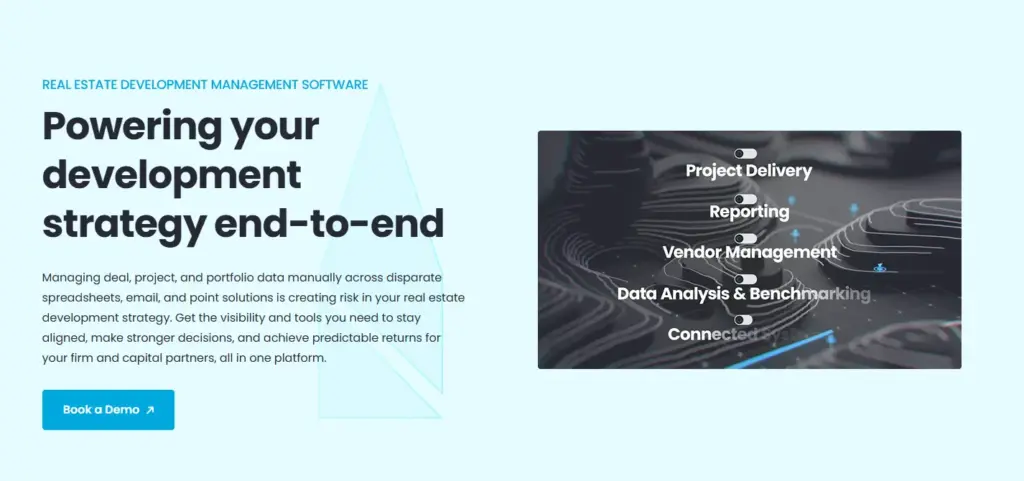
Northspyre is built for owners and development teams rather than contractors, and the centre of the product is the Anticipated Cost Report, which tracks contingency, variance, available funds, cost per square foot, and acquisition cost against the live budget. Around that sit vendor management, invoice approval, draw requests, schedule integration, and portfolio benchmarking across completed projects.
Northspyre does not publish pricing. Third-party directories list a starting range but the figures are inconsistent and low enough to be implausible for a platform of this type, so treat them as noise and get a quote. Northspyre reports average project team time savings of 30% and cost savings of 2% to 8% per project (vendor-reported, not independently verified).
What makes the bill go up is project count and seat count, and the integration scope on the accounting side. Northspyre connects to accounting systems including a three-way integration with Nexus and MRI.
Success signal: reviewers on Software Advice consistently name budget accuracy and the draw request workflow as the features that pay for the platform, and specifically credit the accounting integration, which several note is not standard among development platforms. Failure signal: the recurring complaint is that some accounting functions still require manual work, with reviewers describing the standalone functionality as incomplete against the promise.
Choose it if you are running several development projects at once and your current answer is a spreadsheet per project.
Skip it if you have one project in flight, because the benchmarking value only appears across a portfolio.
2. Rabbet (Best for Construction Draw Management)
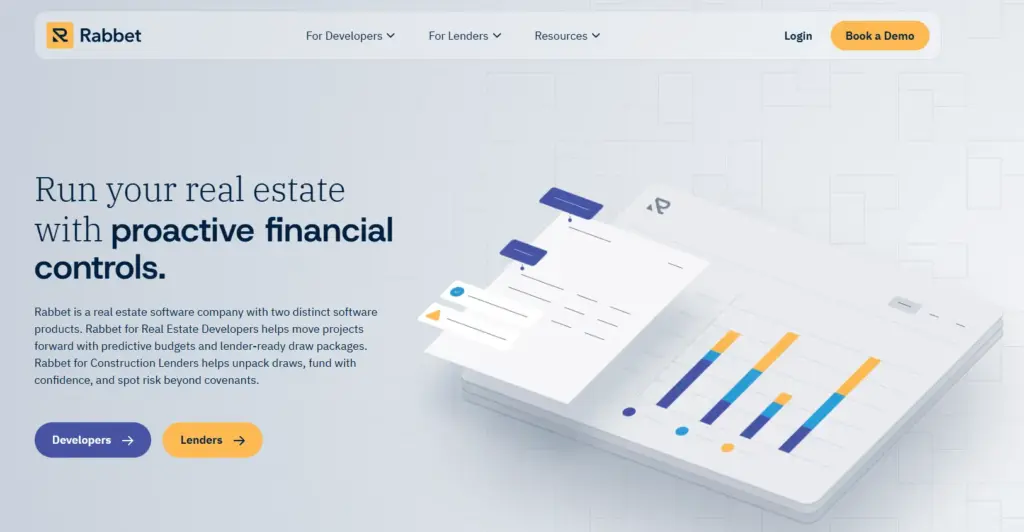
Rabbet serves both sides of the construction finance relationship, which is unusual. For developers it connects budgets, documents, and draw workflows so a lender-ready package can be assembled without a manual document chase. For lenders it standardises inconsistent borrower submissions and flags missing items and covenant exposure before funding.
Pricing is quote-only. Independent review volume is low enough that no sentiment verdict is supportable, which is the honest read rather than a criticism: this is a specialist product with a narrow buyer, not a mass-market platform. Reviewers who have written about it cite the AvidXchange integration for automatic invoice intake as a practical differentiator.
Choose it if draw preparation is consuming a real share of your development team’s month, or you are a lender processing packages from multiple borrowers.
Skip it if your projects are small enough that draws are a quarterly rather than monthly exercise.
3. ARGUS Developer (Best for Feasibility and Appraisal)
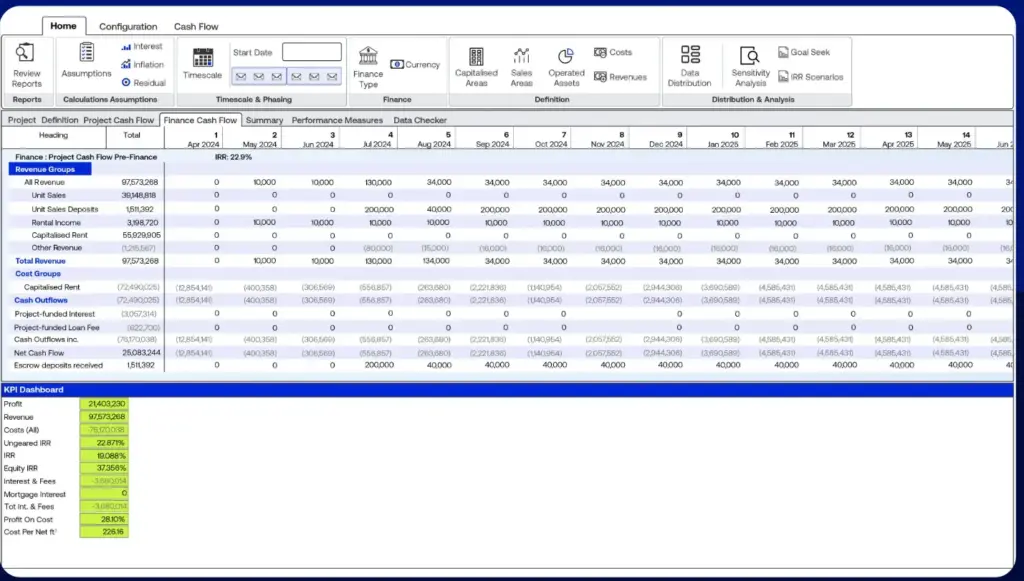
ARGUS Developer is the pre-commitment tool. It models development appraisals and feasibility: profit margin, residual land value, NPV, and IRR against a phased development programme. It is an Altus Group product, sitting alongside ARGUS Enterprise on the asset management side and ARGUS EstateMaster on the feasibility side, and buyers regularly confuse the three.
Ownership and naming note: Altus Group acquired the ARGUS line and has consolidated several products under the ARGUS Intelligence platform. Confirm on your quote which specific product and edition you are licensing, because ARGUS Developer, ARGUS EstateMaster Development Feasibility, and ARGUS Enterprise are distinct licences with distinct prices.
Independent review coverage is very thin, in low single digits on G2 for both Developer and EstateMaster, so no rating on either is worth quoting. Pricing is quote-only.
Choose it if you are appraising land acquisitions and need output in the format lenders and JV partners already read. Skip it if your projects start after land is secured, because the feasibility engine is most of what you would be paying for.
4. Dealpath (Best for Deal Pipeline)
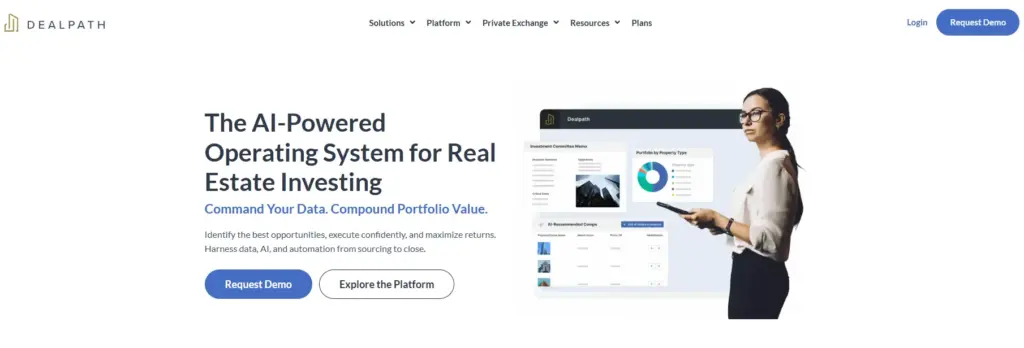
Dealpath is the acquisition-side complement: pipeline management, deal data, task workflow, and investment committee reporting, used by institutional buyers including Blackstone, AEW, Oxford Properties, and Bridge Investment Group. The company reports supporting more than $10 trillion in transactions globally (vendor-reported).
Pricing is quote-only. Capterra shows a small review base of 22 with 95% positive sentiment, which is directionally useful but below the sample size where a score means much on its own.
The real decision is scope. Dealpath covers deal flow up to the point of acquisition. Northspyre covers what happens after. Firms that both acquire and develop generally run one of each rather than finding one system that does both well.
What is the Best Real Estate Portfolio Management Software?
ARGUS Enterprise is the institutional standard for property valuation and portfolio modelling, Agora is the best real estate-specific platform for investor management and the only one here that publishes a starting price, and Juniper Square is the stronger choice for firms managing several asset classes rather than real estate alone.
| Tool | Best for | Published price | Sentiment | Evidence confidence |
|---|---|---|---|---|
| ARGUS Enterprise | Institutional valuation and portfolio modelling | Quote only; free trial available | Positive with recurring concerns | Limited |
| Agora | Real estate specific investor management | From $749/month (Essential) | Generally positive | High |
| Juniper Square | Multi-asset-class fund operations | Quote only; third-party estimates around $18,000/year | Positive with recurring concerns | Medium |
The distinction that decides this category: portfolio tracking software reports on the assets, while investment management software also manages the people who funded them. If you own the equity outright you need the first. If you are a sponsor with limited partners, waterfalls, K-1s, and capital calls, you need the second, and the two are priced an order of magnitude apart.
1. ARGUS Enterprise (Best for Institutional Valuation)
ARGUS Enterprise is the model format institutional real estate speaks in. It handles discounted cash flow and capitalisation-based valuation, lease-level cash flow forecasting, investment return analysis, and portfolio benchmarking. When a lender, appraiser, or acquirer asks for the model, this is usually the file they mean, and that interoperability is most of the purchase argument.
It is an Altus Group product with three editions oriented to portfolio management, valuation, and benchmarking respectively. Altus does not publish pricing, though a free trial is available. Third-party estimates circulate in the range of a few thousand dollars per user per year scaling into enterprise deployments, but they come from directory sites rather than Altus, and the spread between them is wide enough that they are not a budgeting basis.
ARGUS Enterprise holds about 4.1 on G2, but from only 15 reviews, which is too small a sample to carry a verdict. The subscores across that small base are consistent on one point: meets requirements rates 9.0 while ease of use rates 7.2. That gap is the honest summary of the product. It does what institutions need and it is not pleasant to learn.

Choose it if
- your counterparties expect ARGUS models and you are producing valuations rather than consuming them.
Skip it if
- you hold a small portfolio outright, because a spreadsheet and a per-property tracker will cost less and answer the same questions.
2. Agora (Best for Real Estate Specific Investor Management)
Agora is built only for commercial real estate investment firms, and it is the one platform in this section with a published entry price. The Essential plan starts at $749 per month and includes the investor portal, CRM, fundraising tools, and report builder. Professional adds advanced fundraising, data room access, and expanded reporting. Enterprise adds API access, data warehouse exports, and onboarding services.
What makes the bill go up: CPA-managed K-1 preparation, bookkeeping, and cross-border payments are add-on services on any plan, not plan features. Price the services alongside the licence.
Agora holds about 4.8 on G2 across more than 315 reviews, one of the largest independent review bases in this category, and support responsiveness is the most frequently praised attribute. The company reports over $150 billion in assets under management and 70,000 investors on the platform (vendor-reported).
One caution on your research, not on the product. Agora publishes a large volume of comparison content ranking itself against Juniper Square, InvestNext, and AppFolio Investment Manager, and those pages rank well. Several of the third-party pricing figures circulating for competitors originate there. Use them as a starting question for a sales call, not as a verified number.
Choose it if
- you are a real estate sponsor and every asset class in your fund is property.
Skip it if
- you also run venture or credit strategies, because a real estate specific data model becomes a constraint.
3. Juniper Square (Best for Multi-Asset-Class Fund Operations)
Juniper Square began as a real estate sponsor tool and now spans real estate, venture capital, private equity, and credit. Real estate remains its founding and largest vertical. The platform bundles an investor CRM, LP portal, onboarding, reporting, automated capital activity, and optional managed fund administration. As of its June 2025 Series D announcement, the company reported serving more than 2,000 private-markets GPs, managing more than 40,000 funds, and tracking $1 trillion of LP capital (vendor-reported).
Juniper Square does not publish pricing. Third-party sources describe three tiers keyed to equity under management, with a Sponsor tier for firms below roughly $50 million and Professional and Enterprise above that, and figures around $18,000 per year appear in several places. Those figures should be treated carefully, since at least one prominent source repeating them is a direct competitor.
It holds about 4.7 on G2 across 106 reviews.
Success signal: reviewers consistently name fundraising workflow and K-1 delivery as the processes that changed most after adopting it, specifically electronic delivery confirmation and automatic document splitting per investor.
Failure signal: the recurring complaint is not the software. It is the managed fund administration service, where reviewers report inconsistent staffing and variable service quality. Those are two different purchases and they should be evaluated separately.
Choose it if
- you run more than one asset class and want one system of record across all of them.
Skip the fund administration add-on
- until you have spoken to a reference customer who has used it for at least two reporting cycles.
When is Off-the-Shelf Real Estate Software Not Enough?
Off-the-shelf software stops working when your business model does not map to a standard category, when your competitive advantage is the data itself, or when you are building a product for other real estate operators rather than running your own business on software.
Everything above is worth buying if your operation resembles the vendor’s target. Three situations where it does not.
1. Your business model does not fit a standard category. Marketplace platforms, fractional ownership products, co-living operators, and hybrid PropTech businesses do not map onto any single category above. If your product involves multi-party transactions, non-standard fee splits, or a workflow no vendor has a screen for, you will spend engineering time working around the tool rather than building with it, and the workarounds become the system of record.
2. The data is the product. When your edge depends on proprietary data pipelines, custom valuation models, or an investor reporting format your LPs expect, you cannot build that on a platform whose API access, export limits, and pricing you do not control. AppFolio gates API access behind its top tier. Lofty and Yardi do not publish pricing at all. Neither is a foundation for a product whose margin depends on that data.
3. You are building a product, not running a business on software. If you are a PropTech founder building for other real estate operators, you need custom software by definition. You are not the end user. Your customers are, and their workflow is your differentiator.
A fourth reason is the one the LionDesk shutdown makes concrete: continuity. Lone Wolf did not retire the product for lack of customers. It retired it because the product did not fit a roadmap, and everyone who had built a follow-up process on it rebuilt on someone else’s schedule. If a system is load-bearing for revenue, vendor roadmap risk is your risk.
What Does Custom Real Estate Software Development Involve?
The first decision is usually not build versus buy. It is build versus integrate: keep the accounting in QuickBooks, keep the property data in PropStream, and build only the layer that is yours.
For the part you do build, an MVP typically runs three to six months, and the integrations are where the timeline goes, not the interface. What matters most in a custom software development partner here is domain knowledge, not technical execution alone. A team that has not modelled a lease, a rent roll, or a distribution waterfall will build exactly what the spec says and miss the edge cases that break in month two.
TechnBrains has built PropTech platforms serving 685,000+ users, and the recurring lesson is that the data model, not the feature list, decides whether year two of the product is cheap or expensive. Our breakdown of how much it costs to build a real estate app sets the ranges.
Find out which parts of your stack are worth owning
Most operators do not need a full custom platform. Send us your current stack and where it breaks, and we will map what is worth owning and what is fine to keep buying.
Talk to our PropTech teamFinal Thoughts: How Should You Choose the Best Real Estate Software for Your Business in 2026?
Start with the workflow that breaks most often, not the tool with the best reviews. Every category above has a defensible leader, so the real question is which category is costing you time right now.
Then price the total rather than the subscription. Buildium’s higher tier can cost less overall once EFT fees are counted, and AppFolio’s per-unit rate barely matters below roughly 200 units because the monthly minimum is the actual price. Skip tracing, onboarding, and per-seat calling are all billed separately.
Before you migrate a database into anything, check who owns the product and what you are allowed to export. Follow Up Boss is a Zillow product. Buildium is a RealPage company. LionDesk does not exist anymore. The best real estate software is the one you can still leave.
Table of Contents
Frequently Asked Questions
Real estate software is any system that manages part of the real estate lifecycle, from lead capture to property operations to investor reporting. It divides into six categories: CRM, property management, investment and portfolio management, accounting, commercial real estate management, and marketing.
HubSpot's free tier is the most capable no-cost option, and unlike a trial it does not expire. The tradeoff is that it carries no MLS or IDX integration, so listing data stays manual. Wise Agent and Follow Up Boss run free trials rather than free tiers, and LionDesk's free option disappeared with the product in September 2025. In practice, a free real estate CRM means a general-purpose CRM you configure yourself.
For investors tracking equity, cash flow, and returns across properties they own, Stessa covers per-property reporting on a free tier and QuickBooks handles multi-entity structures. For sponsors managing outside capital, AppFolio Investment Manager and InvestNext add investor portals, waterfalls, and distributions. The distinction matters when shortlisting: portfolio tracking software reports on the assets, while investment management software also manages the people who funded them.
Agent-level tools run $14 to $99 per month. Property management platforms range from free for self-managing landlords to $62 to $400 per month for small-to-mid portfolios, with per-unit pricing and monthly minimums above that. Investment management platforms start around $499 to $650 per month, and enterprise commercial systems are quote-based and commonly reach six figures annually. Budget separately for transaction fees, skip tracing, onboarding, and per-seat add-ons, which routinely add 30% or more.
Build when your workflow does not fit any vendor category, when proprietary data or models are your competitive advantage, or when you are building a product for other operators.
A CRM manages relationships before a transaction: leads, follow-up, and pipeline. Property management software manages operations after one: leases, rent collection, maintenance, and owner reporting. They overlap at the tenant record and almost nowhere else, which is why most operators run both.
Northspyre for development cost control and forecasting across multiple projects, Rabbet for construction draw and lender workflows, and ARGUS Developer for feasibility and residual land value modelling before a project is committed. None of the three publishes pricing. Development software is distinct from construction management software, which is bought by the general contractor rather than the owner.
Development software is bought by the owner and tracks the money: budget, contingency, change orders, draws, and capital partner reporting. Construction management software is bought by the general contractor and tracks the build: submittals, RFIs, drawings, and field coordination. Owners who act as their own general contractor need both.
Re-Leased is the strongest fit for commercial portfolios below enterprise scale, because it models commercial lease terms natively while integrating with Xero or QuickBooks instead of carrying its own general ledger. Yardi Voyager and MRI are built for portfolios large enough to justify a configuration project, and below that the setup effort outweighs the capability.
Outgrown off-the-shelf real estate software?
We build the platforms operators move to when vendor software stops fitting.