Build and Scale Faster
150+ products shipped for startups and enterprises by engineers focused on real outcomes.
"Their ability to quickly understand an unfamiliar use case and respond creatively to it is impressive."

Anonymous
Executive, Pured Disc Golf

"TechnBrains resolved challenges efficiently and turned my vision into a solid, functional product with a strong foundation."

Jalen Gibbs
Founder, STREAMLINE LIVE
"The talent they provided was solid, but more importantly, they were quick to align with our way of working."

Nancy Snyder
Managing Director, MimeCast
Our trusted clients


Start Your Product Journey Today
Turn your idea into a working product. Share a few details and we'll help define the roadmap, timeline, and execution approach.
Enterprise Software Development (All You Need to Know in 2024)
The Million Dollar Question: What is Enterprise Software Development? Is It The Answer to Your Growth Dilemma? Imagine this: Your business is booming. New customers are pouring in, but your existing systems are creaking at the seams. Manual processes are slowing you down, data silos are hindering collaboration, and your competitors seem to be a step ahead. You know you...


Updated Apr 30, 2024
The Million Dollar Question: What is Enterprise Software Development? Is It The Answer to Your Growth Dilemma?
Imagine this: Your business is booming. New customers are pouring in, but your existing systems are creaking at the seams. Manual processes are slowing you down, data silos are hindering collaboration, and your competitors seem to be a step ahead. You know you need a change, but the vast landscape of software solutions can be overwhelming. Is custom enterprise software the answer to your growth dilemma? The answer is yes; Enterprise software development helps large organizations enhance their operations, improve efficiency, and drive growth.
According to Grandviewsearch, The enterprise software market was valued at USD 216.69 billion in 2022 and is projected to grow at 11.5% CAGR from 2023 to 2030.
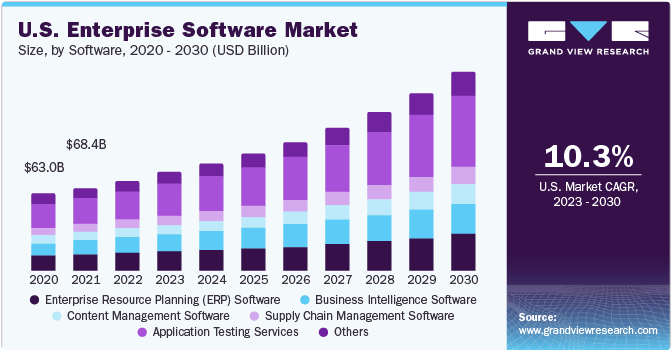
Source: Grand View Research
This comprehensive guide, specifically designed for business decision-makers like you, will help you navigate the world of enterprise software development. We will break down the key concepts, explore the potential benefits, and guide you through crucial considerations before making a strategic investment. By the end, you will be empowered to make informed decisions that can unlock a future of growth and success for your organization.
What is Enterprise Software Development?
Enterprise software development involves creating complex solutions that integrate with existing systems, manage large-scale data, and meet strict security, compliance, and industry standards. To understand this better as a business owner, a custom software solution tailored to your business is designed to drive your growth goals and surpass the limitations of off-the-shelf software.
Enterprise Software Development Types
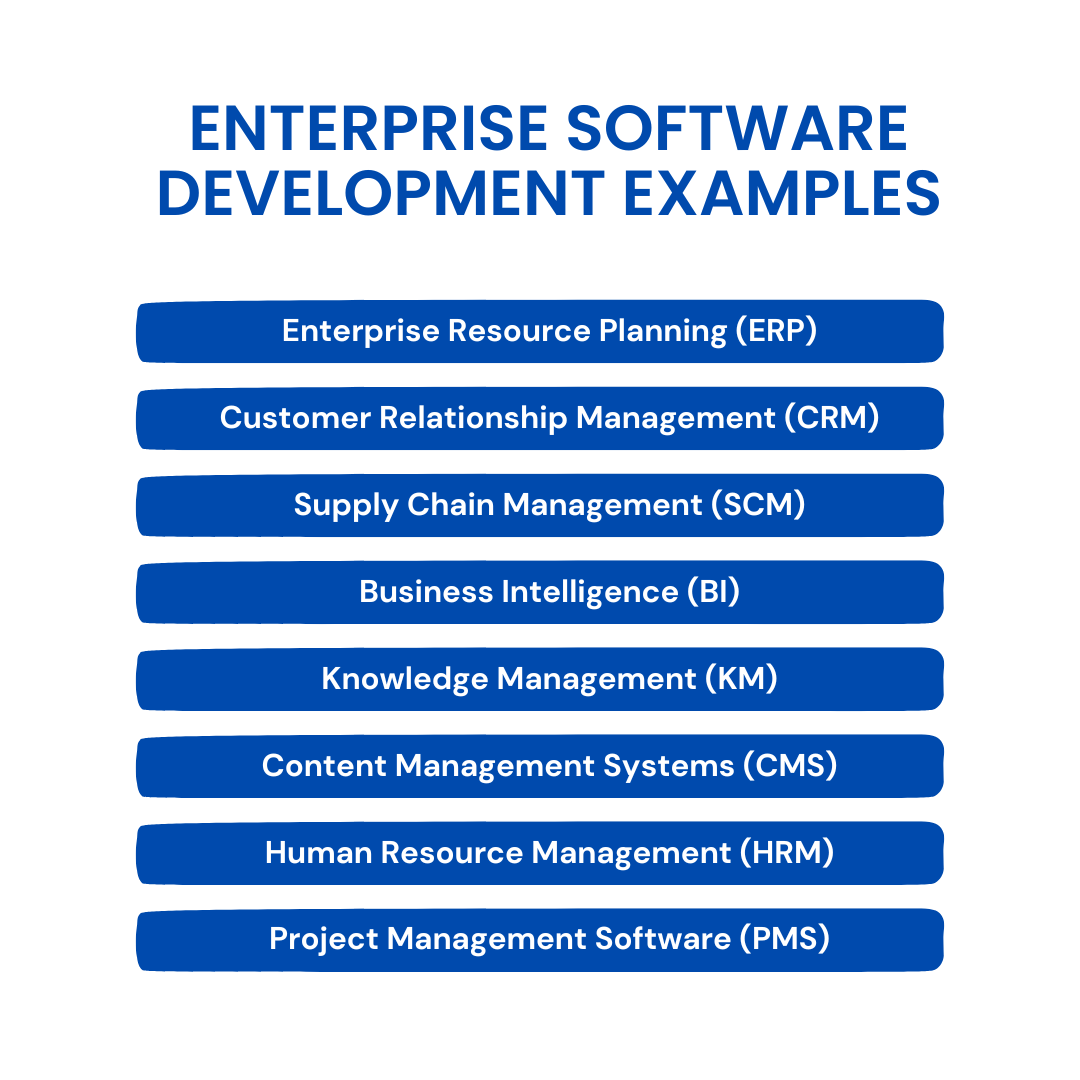
Enterprise software development encompasses a broad spectrum of solutions. However, some of the most common types of enterprise software development are:
- Enterprise Resource Planning (ERP)
- Customer Relationship Management (CRM)
- Supply Chain Management (SCM)
- Business Intelligence (BI)
- Knowledge Management (KM)
- Content Management Systems (CMS)
- Human Resource Management (HRM)
- Project Management Software (PMS)
Let us now explore the most common types based on their functionalities below in detail:
1. Enterprise Resource Planning (ERP)
This is a comprehensive software suite that integrates and manages core business functions like accounting, finance, human resources, supply chain management, customer relationship management (CRM), and manufacturing. It provides a holistic view of your organization’s operations and streamlines data flow across departments.
2. Customer Relationship Management (CRM)
CRM software focuses on managing all aspects of a customer’s journey with your organization. It includes functionalities for sales force automation, marketing automation, customer service, and lead management. CRM systems help you build stronger customer relationships, improve lead conversion rates, and boost customer satisfaction.
3. Supply Chain Management (SCM)
SCM software optimizes the flow of goods, materials, and information throughout your supply chain. It helps you manage inventory levels effectively, track shipments in real time, and collaborate seamlessly with suppliers and vendors. This leads to improved efficiency, reduced costs, and enhanced customer satisfaction through faster delivery times.
4. Business Intelligence (BI)
BI software focuses on transforming raw data into actionable insights. It provides tools for data warehousing, data visualization, and analytics, allowing you to identify trends, monitor key performance indicators (KPIs), and make data-driven decisions across all levels of your organization.
5. Knowledge Management (KM)
KM systems facilitate the creation, storage, retrieval, and sharing of organizational knowledge. This can include documents, reports, best practices, and other intellectual assets. KM software helps teams collaborate more effectively, reduces duplication of effort, and ensures everyone has access to the latest information.
6. Content Management Systems (CMS)
CMS platforms allow you to create, edit, manage, and publish website content without needing extensive coding knowledge. This empowers non-technical users to maintain websites, blogs, and other online platforms, promoting user-friendly content creation and management.
7. Human Resource Management (HRM)
HRM software streamlines all aspects of human resources management, including employee onboarding, payroll processing, performance management, and talent acquisition. This allows HR departments to automate tasks, improve efficiency, and focus on strategic initiatives.
8. Project Management Software
These solutions empower teams to collaborate effectively on projects, manage tasks and deadlines, track progress, and share resources. This improves communication, reduces project risks, and ensures projects stay on track and within budget.
Targeted Enterprise Software for Your Industry
- Enterprise Resource Planning (ERP):
- Industry: Manufacturing (e.g., clothing company)
- Benefit: Streamline production, manage inventory, and automate accounting tasks, allowing you to focus on design and brand growth.
- Customer Relationship Management (CRM):
- Industry: E-commerce (e.g., sporting goods store)
- Benefit: Understand customer buying habits, personalize marketing campaigns, and improve customer service for repeat business and positive reviews.
- Supply Chain Management (SCM):
- Industry: Restaurant chain
- Benefit: Track food inventory levels, optimize deliveries to avoid spoilage, and manage supplier relationships for cost-effective ingredients.
- Business Intelligence (BI):
- Industry: Fitness studio chain
- Benefit: Analyze class attendance data, identify popular programs, and optimize pricing strategies to maximize revenue and member satisfaction.
- Knowledge Management (KM):
- Industry: Construction Company
- Benefit: Store project plans, safety protocols, and best practices for new hires to access easily, ensuring consistent quality and efficient project execution.
- Content Management Systems (CMS):
- Industry: Photography studio
- Benefit: Easily update your online portfolio, showcase your work, and manage client galleries – all without needing coding expertise.
- Human Resource Management (HRM):
- Industry: Legal firm
- Benefit: Automate payroll and benefits processing, streamline recruiting efforts, and track employee performance for a more efficient and engaged workforce.
- Project Management Software (PMS):
- Industry: Marketing Agency
- Benefit: Manage client projects effectively, assign tasks to team members, track deadlines, and collaborate seamlessly for successful campaign execution.
Knowing your ESD options as a business owner can help you make informed decisions that unlock your organization’s growth potential.
Benefits of Enterprise Software Development
Enterprise software development has various benefits. Some of them are tailor-made functionality, Scalability & Future-Proofing, Enhanced Data Management, Robust Security & Compliance, and Streamlined Collaboration. To understand the advantages of Enterprise software development better, here’s what sets enterprise software development apart:
Tailor-Made Functionality
Forget cookie-cutter solutions. Enterprise software revolves around your unique workflows and processes. Imagine a system that seamlessly integrates with your existing infrastructure, automates tedious tasks, and empowers your workforce with user-friendly tools specifically designed for their roles.
Scalability & Future-Proofing
Growth is a beautiful problem to have, but it can wreak havoc on generic software. Enterprise software is built to scale effortlessly alongside your organization. You won’t be left scrambling for a new solution every time you take on new customers or expand into new markets.
Enhanced Data Management
Information silos are a thing of the past with enterprise software development. It fosters a unified data environment, allowing you to unlock valuable insights from your data and make data-driven decisions with greater confidence across all levels of your organization.
Robust Security & Compliance
As business owners, we know the importance of security in custom software development. A breach can be devastating. In enterprise software development, robust security measures are a top priority. Your sensitive data will be safeguarded, ensuring compliance with industry regulations and protecting your business reputation.
Streamlined Collaboration
Communication barriers can cripple productivity. Enterprise software facilitates seamless collaboration between teams and departments, regardless of location. With a centralized platform for information sharing and project management, everyone in your organization can be on the same page.
These are just a few of the key benefits that differentiate enterprise software development from its generic counterparts. In the next section, we’ll delve deeper into the advantages of enterprise software development that extend beyond a single department or role. Let’s explore how this powerful tool benefits different members of your organization.
Enterprise Software Development for Business Owners
Business Owners, this section is solely for you. ESD can result in Increased Efficiency and cost Savings. Automating repetitive tasks and streamlined workflows leads to significant time and resource savings. You can free up your workforce to focus on higher-value activities and invest those saved resources in other areas of growth.
It can also lead to Improved Decision-Making. Real-time data insights and comprehensive reporting empower you to make informed decisions based on concrete facts rather than gut feelings. This data-driven approach can significantly improve your strategic planning and resource allocation.
Enterprise software development can enhance your organization’s customer experience. It can help you personalize interactions with your customers, improve response times, and anticipate their needs. This fosters stronger customer loyalty and drives repeat business.
Custom-built enterprise software can give you a significant advantage by automating tasks, optimizing processes, and driving innovation through unique functionalities not available with generic solutions.
Enterprise Software Development for Project Managers & IT Professionals
To carry out a successful ESD project, project managers and IT professionals must collaborate. In certain cases, IT staff augmentation services can enhance your team’s capabilities, thereby guaranteeing that you have the requisite knowledge to deliver an innovative solution.
Enterprise software development Improves Project Management. It often adopts methodologies like Agile, which enable flexible project management, faster iterations, and better communication with stakeholders.
It also helps you reduce risk and Improve Communication within the team. Clearer requirements gathering, streamlined software development processes, and robust testing procedures help mitigate project risks and ensure a smooth implementation.
Last but not least, ESD aids in enhancing system maintenance and scalability. Enterprise software is designed for long-term use and scalability. Your IT team will have a robust platform to manage, maintain, and scale the system effortlessly as your business grows.
Enterprise Software Development for Developers
Enterprise software development isn’t just about building software – it’s about pushing boundaries and shaping the future of an organization. For developers, it’s a playground teeming with technical challenges, groundbreaking technologies, and the potential to make a real impact. This realm offers not only a thrilling work environment but also a Launchpad for significant career development. Need to hire dedicated developers to tackle your ESD project? We’ll explore that aspect later, but first, let’s delve into the exciting world of ESD for developers:
- Technical Challenge & Growth: Enterprise software development is far from cookie-cutter. It demands the use of advanced technologies like cloud computing, robust APIs, and complex data structures. Every project presents a unique set of challenges, pushing developers to refine their existing skills and master cutting-edge technologies. This continuous learning curve ensures you’ll always be energized and always have opportunities to expand your technical expertise.
- Career Development: ESD expertise is a coveted skill set in the IT industry. By participating in these projects, you’ll build a strong portfolio showcasing your ability to handle large-scale, complex software development. This not only makes you highly desirable to potential employers but also opens doors to exciting career opportunities in various industries and at top-tier companies.
Building Your Dream Team by Hiring Dedicated Developers
Now, let’s address the practical side of things. Assembling the right team for an ESD project is crucial. While some companies have in-house development teams, others might require external resources to bridge skill gaps or for specific project phases. Here’s where hiring dedicated developers comes in:
- Filling Skill Gaps: If your internal team lacks the specific expertise required for your ESD project, hiring dedicated developers with the necessary skills can be a strategic solution. This allows you to access specialized knowledge and experience without the commitment of permanent hires.
- Scalability & Flexibility: ESD projects can be resource-intensive. Hiring dedicated developers offers scalability – you can adjust the team size based on project needs, ensuring you have the right talent at each stage.
- Focus & Efficiency: Bringing on a dedicated development team allows your internal team to focus on their core competencies. This fosters greater efficiency and streamlines the overall development process.
What Are Enterprise Software Development Technologies?
Enterprise software technologies are tools used to manage functions and processes within an organization. It includes enterprise resource planning, customer relationship management, enterprise marketing automation, and other services that help optimize operations, increase efficiency, and streamline communications. These technologies free up company resources and provide a better experience for both employees and customers. Here’s a quick rundown of the essential tools in an ESD developer’s toolkit:
- Programming Languages: Java, Python, C#, and .NET are the workhorses chosen for their scalability and large developer communities.
- Databases: Think data storage powerhouses. Relational databases (MySQL, PostgreSQL) handle structured data, while NoSQL databases (MongoDB) offer flexibility for less-structured information.
- Cloud Platforms: Cloud giants like AWS, Azure, and GCP provide the infrastructure and agility to run your enterprise software efficiently.
- API Management Tools: APIs are the glue that connects your software to other systems. Tools like Apigee or Mulesoft ensure smooth data exchange.
- Development Frameworks: Frameworks like Spring, Django, or ASP.NET accelerate development by providing pre-built components and enforcing coding best practices.
- Version Control Systems: Version control (e.g., Git) keeps track of code changes, allowing for collaboration and easy rollbacks if needed.
This is just a starting point. Security measures, Business Intelligence tools, and mobile development options might also be part of the mix, depending on your project’s specific requirements. When building enterprise software, remember the right technology stack is crucial for a secure, scalable, and efficient solution.
What are the five stages of enterprise software development?
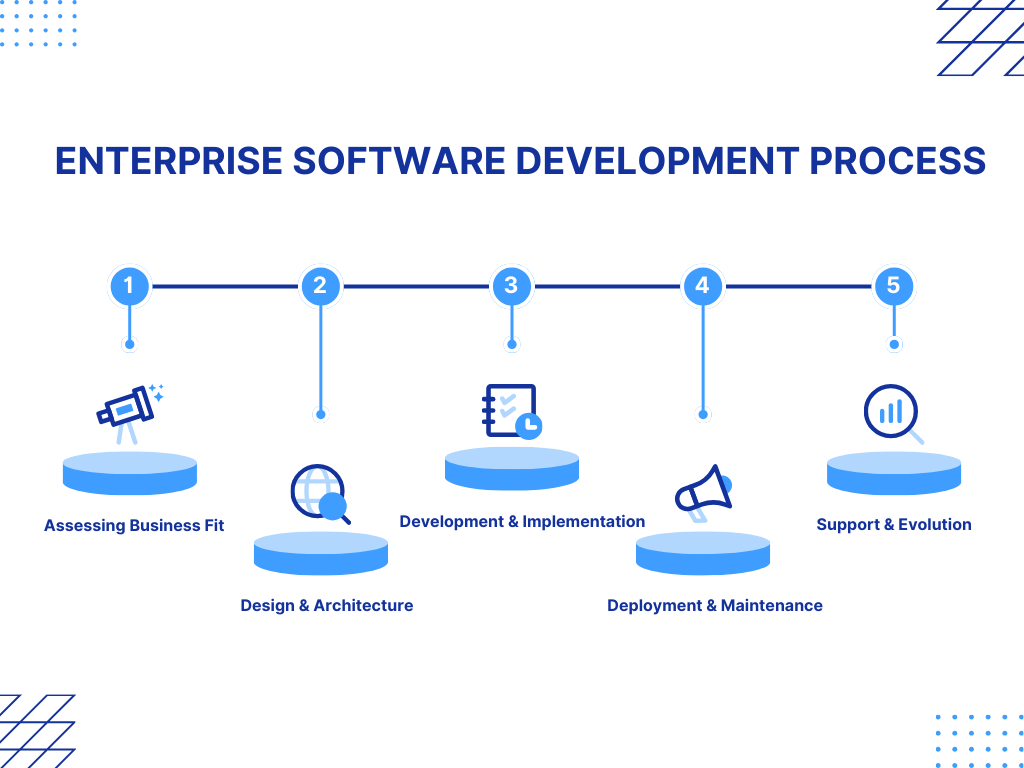
The 5 stages of enterprise software development are:
- Assessing Business Fit
- Design & Architecture
- Development & Implementation
- Deployment & Maintenance
- Support & Evolution
These stages of enterprise software development provide a clear roadmap for navigating this complex process. Here’s a concise breakdown of each one:
1. Assessing Business Fit
This initial stage involves a thorough analysis of your business needs, workflows, and pain points. Workshops, interviews, and user stories help gather detailed requirements to ensure the final software effectively addresses your challenges.
2. Design & Architecture
Based on the needs assessment, architects design the system’s infrastructure, data models, and user interfaces. During this critical planning phase, scalability, security, and integration considerations are factored in.
3. Development & Implementation
The chosen development methodology (Agile, Waterfall, etc.) guides the development process. Developers build and test individual features iteratively, ensuring continuous feedback and refinement.
4. Deployment & Maintenance
Once development is complete, the software undergoes rigorous testing before being deployed in a controlled environment. Ongoing maintenance and support are crucial to address bugs, ensure system uptime, and incorporate future enhancements.
5. Support & Evolution
Enterprise software is rarely static. This final stage encompasses ongoing support for users, bug fixes, and the implementation of new features based on evolving business needs. This ensures your software remains relevant and continues to deliver value to your organization.
Best Practices for Developing Enterprise Software For Business Owners
Here are some best practices for developing enterprise software for business owners:
Prioritize Business Needs
- Focus on Value: Always keep the end goal in mind. The software should address specific business challenges, improve workflows, and ultimately drive growth.
- Align with Strategy: Ensure the software aligns with your overall business strategy and supports your long-term goals.
Embrace Collaboration & Communication
- Involve Stakeholders Early: Get key stakeholders like department heads and end-users involved from the start. Their input helps ensure the software meets their needs and addresses real-world challenges.
- Clear Communication: Maintain open and transparent communication with stakeholders throughout the development process. Keep them informed of progress, address concerns, and manage expectations.
Build for Flexibility & Scalability
- Future-Proofing: Don’t design for today’s needs only. Consider potential future growth and ensure the software can scale to accommodate new features and increased user volume.
- Open Architecture: Opt for an open architecture that allows for easy integration with existing systems and future third-party solutions.
Prioritize Security & User Experience
- Robust Security: Security is paramount. Implement strong security protocols to safeguard sensitive data and ensure compliance with industry regulations.
- User-Centric Design: Focus on user experience (UX) by designing an intuitive and user-friendly interface. Consider user workflows and training needs to promote user adoption.
Plan for Maintenance & Support
- Long-Term Vision: Enterprise software is an ongoing investment. Factor in maintenance costs and establish a support plan to address bugs, provide ongoing updates, and ensure system uptime.
- Documentation & Training: Develop comprehensive documentation and training materials to empower users and minimize support requests.
Additional Tips
- Consider Agile Development: Agile methodologies allow for iterative development and continuous feedback, making it easier to adapt to changing requirements.
- Start with an MVP (Minimum Viable Product): Build a core version with essential functionalities first. Gather user feedback and iterate based on their experience.
- Choose the Right Development Partner: Select an experienced and reliable development partner with a proven track record in enterprise software development.
By following these best practices, business owners can ensure their enterprise software development project is successful and delivers tangible value to their organization.
Enterprise Software Development vs. Regular Software Development
This section will explore the key differences between enterprise software development and regular software development.
Enterprise Software Development
As discussed above, Enterprise software development addresses the intricate requirements of big organizations. It manages diverse user bases and multiple workflows while integrating with existing legacy systems and handling large data volumes.
Regular Software Development
Regular software development, on the other hand, focuses on creating applications for a broader audience or a specific use case. Think mobile apps, productivity tools, or even basic web applications. These applications are more focused in scope and may have shorter development lifecycles compared to enterprise software.
Enterprise Software Development vs. Regular App Development
Now, let’s delve into the specific areas that differentiate these two development approaches:
- Complexity: Enterprise software development tackles intricate challenges. Scalability to accommodate thousands of users, seamless integration with legacy systems, and robust security protocols are all paramount considerations. Regular software development, while still requiring skilled developers, might have less demanding feature sets and integration requirements.
- Development Lifecycle: The development journey for enterprise software is often longer. Extensive testing and stringent quality assurance procedures are essential to ensure system stability and reliability when dealing with critical business operations.
- Deployment & Security: Securing sensitive data and ensuring system uptime are top priorities in enterprise software development. Strict security protocols and robust deployment strategies are implemented to safeguard critical information. Regular software development may have varying security requirements depending on the application’s purpose and data sensitivity.
- Scalability & Performance: Enterprise software must be built to handle massive user bases and process large amounts of data efficiently. Scalability becomes a central concern, requiring architects to design systems that can grow alongside the organization’s needs. Regular software development might have less demanding scalability needs, depending on the targeted user base and application functionality.
- User Base & Needs: Enterprise software caters to a diverse user base within a large organization with varying roles and workflows. Understanding and addressing these diverse needs requires careful user research and a focus on intuitive user interfaces. Regular software development may target a more specific user group with well-defined needs, allowing for a more streamlined user experience design.
- Cost & Resources: Enterprise software development often has a higher price tag. Complex functionality, specialized skillsets like experienced enterprise software developers, and extensive testing procedures all contribute to the cost. Regular software development can be more cost-effective due to a potentially smaller development team and less demanding technical requirements.
The Takeaway
So, what is the difference between enterprise software development and regular software development? The answer is Enterprise software is complex, expensive, and requires extensive testing and strict security protocols. Regular software is less complex, more flexible, and can be more cost-effective.
Challenges & Considerations in Enterprise Software Development
While the rewards of enterprise software development are undeniable, it’s important to acknowledge the inherent challenges that come with building complex custom solutions. Here are some key considerations to navigate:
Security & Compliance
Safeguarding sensitive data is paramount. Security protocols like encryption, access controls, and regular penetration testing are crucial to prevent breaches. Additionally, ensuring compliance with relevant industry regulations like HIPAA or GDPR is essential.
Integration Complexity
Existing legacy systems might integrate differently with your new enterprise software. Careful planning, data mapping strategies, and the use of integration technologies like APIs or middleware are necessary to bridge these gaps and ensure smooth data flow.
Scalability & Maintainability
Your software needs to accommodate future growth. Choose a scalable architecture that can effortlessly adapt to increasing user bases and data volumes. Additionally, consider maintainability – the software should be designed with clear documentation and modular components to simplify future updates and bug fixes.
Project Management & Communication
Effective project management is vital for success. Agile methodologies or similar iterative approaches foster clear communication between stakeholders, developers, and end-users. Regular feedback loops and a well-defined communication plan ensure everyone is on the same page throughout the development process.
Cost & ROI
Enterprise software development is an investment. However, a well-defined needs assessment and a clear understanding of the return on investment (ROI) can help justify the cost. Focus on measurable outcomes and long-term benefits like increased efficiency, cost savings, and improved customer satisfaction.
Absolutely, here’s the revised content to fit under the heading “Enterprise Software Development Cost”:
Enterprise Software Development Cost
Custom enterprise software development can transform your organization’s operations and give you a competitive edge. But it’s important to understand the costs. The price depends on several factors and can vary greatly. Based on our exposure, most custom projects cost between $100,000 and $750,000 for design, development, and implementation.
Factors Affecting the Cost of Enterprise Software Development
Several factors can influence the overall cost of your enterprise software development project:
- Project Scope & Complexity: The size and intricacy of your software directly affect the development effort required. Larger, more complex projects with numerous features naturally cost more than simpler applications.
- Technology Stack: The specific programming languages, frameworks, and databases chosen can impact the cost. Cutting-edge technologies or niche skills may require higher developer rates.
- Development Team Location: The location of your development team (in-house, nearshore, offshore) can influence costs. Developer rates vary depending on geographical location and experience level.
- Project Methodology: The chosen development methodology (Agile, Waterfall, etc.) can affect costs. Agile approaches often involve iterative development cycles, which can lead to adjustments and impact the overall budget.
- Ongoing Maintenance & Support: Factor in the cost of ongoing maintenance and support after deployment. This ensures bug fixes, updates, and long-term system uptime.
Future Trends in Enterprise Software Development
As a business owner or IT professional, staying abreast of these trends is key to ensuring your software remains competitive and continues to propel your organization forward. Here’s a glimpse into some of the exciting developments shaping the future of ESD:
1. The Rise of Low-Code/No-Code Development
Traditional software development requires extensive coding expertise. Low-code/no-code platforms are changing the game by empowering “citizen developers” – business users with limited coding experience – to build simple applications for their specific needs. This democratizes app development within organizations, fostering innovation and streamlining processes without relying solely on professional developers.
2. Artificial Intelligence & Machine Learning (AI/ML)
Integrating AI and ML capabilities into enterprise software unlocks a new level of automation, intelligence, and efficiency. These technologies can be leveraged for:
- Predictive Analytics: Analyze data to anticipate future trends, optimize resource allocation, and make data-driven decisions.
- Chatbots & Virtual Assistants: Improve customer service by providing 24/7 support through chatbots or virtual assistants powered by AI.
- Automated Workflows: Automate repetitive tasks, freeing up human resources for more strategic work and reducing the risk of human error.
3. Cloud-Native Applications
Cloud computing has revolutionized the way we deploy and manage software. Cloud-native applications are specifically designed to leverage the inherent scalability and elasticity of cloud platforms. This offers several benefits:
- Rapid Scalability: Easily scale your software up or down based on changing user demands, ensuring optimal performance and cost-efficiency.
- Increased Availability: Cloud platforms offer high availability, ensuring minimal downtime and uninterrupted business operations.
- Improved Agility: Cloud-based deployments allow for faster development cycles and easier updates, enabling your software to adapt quickly to evolving needs.
4. The Growing Importance of User Experience (UX)
Today’s users expect a seamless and intuitive user experience. Businesses are increasingly recognizing the value of investing in UX design for their enterprise software.
- Enhanced User Adoption: A well-designed interface encourages users to readily adopt and embrace the new software, maximizing its value within your organization.
- Improved Productivity: Intuitive workflows and user-friendly features minimize training needs and empower users to work more efficiently.
- Increased Employee Satisfaction: A positive user experience contributes to a more satisfied and productive workforce.
5. Growing Focus on Security & Data Privacy
As reliance on enterprise software grows, so does the responsibility to safeguard sensitive data. Here are some key security trends:
- Zero-Trust Security: This approach assumes no user or device is inherently trustworthy. Multi-factor authentication and continuous access controls ensure that only authorized users can access sensitive data.
- Data Encryption: Encrypting data at rest and in transit minimizes the risk of unauthorized access and data breaches.
- Compliance with Regulations: Businesses must comply with industry regulations like GDPR (General Data Protection Regulation) and HIPAA (Health Insurance Portability and Accountability Act).
Building for People, Not Just Processes
While automation and powerful technologies are at the heart of enterprise software development, it’s crucial to remember the human element. Here’s how to ensure your custom solution empowers your workforce:
- User-Centric Design: Involve end-users in the design process through user testing and feedback sessions. This ensures the software is intuitive and user-friendly and addresses their specific needs and workflows.
- Change Management Strategy: Implementing new software can be disruptive for some employees. Develop a comprehensive change management strategy to train your workforce on the new system, address concerns, and foster user adoption.
- Communication & Transparency: Keep your employees informed throughout the development process. This will help build trust and ownership and promote a smooth transition to the new software platform.
The Powerhouse Within Your Reach
The journey of enterprise software development can be transformative, propelling your organization towards greater efficiency, productivity, and a competitive edge. This comprehensive guide has equipped you with the knowledge to navigate this journey effectively. Remember, it all starts with a clear understanding of your business needs and a commitment to building a custom solution that empowers your people and fuels your growth aspirations.
Get Your Groundbreaking Enterprise Software Solutions from TechnBrains
Are you looking to enhance your organization’s enterprise software development capabilities? Look no further than TechnBrains – a leading enterprise software development company with a wealth of experience in developing customized enterprise solutions. Our team of skilled developers can assist you throughout the entire process, from needs assessment and planning to deployment and ongoing support. Contact us today to schedule a free consultation and discover how we can help you build an internal powerhouse to take your business to the next level.
In This Article

Blocked by Backlog or Missed Deadlines?
Senior developers who build, fix, and ship, without slowing your team down.