Build and Scale Faster
150+ products shipped for startups and enterprises by engineers focused on real outcomes.
"Their ability to quickly understand an unfamiliar use case and respond creatively to it is impressive."

Anonymous
Executive, Pured Disc Golf

"TechnBrains resolved challenges efficiently and turned my vision into a solid, functional product with a strong foundation."

Jalen Gibbs
Founder, STREAMLINE LIVE
"The talent they provided was solid, but more importantly, they were quick to align with our way of working."

Nancy Snyder
Managing Director, MimeCast
Our trusted clients


Start Your Product Journey Today
Turn your idea into a working product. Share a few details and we'll help define the roadmap, timeline, and execution approach.
How Custom App Development Drives Real Business ROI at Scale
When a CTO signs off on a $200k–$1M custom application, it’s not a technology decision. It’s a capital allocation decision. I’ve watched too many companies approve projects that looked great on a roadmap but never showed up in revenue, throughput, or margin because the software was built to check feature boxes, not to change how the business actually operates. Custom...

Updated Jul 09, 2026
When a CTO signs off on a $200k–$1M custom application, it’s not a technology decision. It’s a capital allocation decision.
I’ve watched too many companies approve projects that looked great on a roadmap but never showed up in revenue, throughput, or margin because the software was built to check feature boxes, not to change how the business actually operates.
Custom app development only delivers ROI when it rewires three things: how fast work moves, how much each transaction costs, and how quickly new revenue features can be shipped. That’s the difference between software that “runs the business” and software that grows it.
McKinsey estimates that digital automation of core processes can lift productivity by 20–30%, directly impacting operating margins and scalability.
This article breaks down where that ROI really comes from and how to model it before you spend a dollar.
Key Takeaways
- Custom app development delivers higher ROI than SaaS because it reduces cost per transaction, accelerates revenue workflows, and lowers long-term software spend.
- CTOs and CFOs model ROI by comparing labor saved, SaaS eliminated, and revenue unlocked against build and maintenance costs over three to five years.
- When a custom platform automates lead-to-cash, fulfillment, billing, and support, marginal cost drops as volume grows, creating compounding returns that packaged software cannot achieve.
How does custom app development turn engineering investment into measurable revenue growth and operational ROI?
Custom app development turns engineering spend into ROI by shortening revenue cycles, lowering the cost of execution, and making it cheaper to ship new money-making features.
That is the mechanism. Not “better software”, but better economics per transaction and per release.
Here’s what that looks like in real delivery terms. When your sales, operations, and data pipelines run on the same custom platform, you remove the friction that kills ROI in SaaS stacks: duplicate data entry, broken handoffs, and integrations that lag behind the business.
Deals close faster because pricing, onboarding, and provisioning are connected. Ops costs drop because fewer people are needed to move the same volume.
Product revenue grows because features can be released without fighting vendor limits or API gaps.
That is why custom apps show up on financials as higher throughput, lower cost per unit, and faster payback, not just as IT assets.
Which business processes create the highest ROI when automated or redesigned through custom software?
The highest ROI comes from processes that sit directly on the money path. Anything that touches lead to cash, order to fulfillment, or service to renewal compounds returns when it is custom-engineered.
| Process | Why It Leaks Money in SaaS Stacks | How Custom Apps Change the Economics |
| Lead → Deal | CRMs don’t match your sales logic | Custom scoring, routing, and pricing lift close rates |
| Order → Fulfillment | Manual steps and re-keying | Straight-through processing cuts cycle time and errors |
| Billing → Cash | Disputes and slow invoicing | Automated billing improves cash flow and revenue capture |
| Support → Retention | Agents lack full customer context | Unified data lowers cost and increases renewals |
| Data → Decisions | Conflicting reports | Real-time operational data improves execution speed |
These are not back-office tasks. These are where ROI is created or lost. Custom software makes them predictable instead of fragile.
Why do off-the-shelf platforms cap ROI while custom-built systems compound value as companies scale?
Because every new dollar of growth makes SaaS more expensive and harder to run, while it makes custom platforms cheaper and easier to operate.
I’ve never seen a company scale to $50M+ on pure SaaS without its unit economics getting worse.
Here’s why. The SaaS stack always looks fine at 20 people. At 100, it starts creaking. At 300, it becomes a tax on every transaction. You pay per seat, per module, per API call, per integration. Then you hire people just to keep those systems talking to each other.
With a custom platform, that curve flips. Once you’ve built your sales, billing, fulfillment, and reporting logic into one system, adding another thousand customers costs you almost nothing. That’s where ROI compounds.
How do SaaS licensing costs, integration debt, and workflow constraints change the long-term economics compared to custom apps?
| What I watch in real companies | SaaS stacks do this | Custom platforms do this |
| Every new hire | Adds another license | Adds more output on the same system |
| Every new product | Needs more tools | Uses the same workflows |
| Every new market | Breaks integrations | Reuses the same core logic |
| Every new report | Comes from three systems | Comes from one source |
| Every year | Software bill goes up | Cost per transaction goes down |
That’s the real difference. SaaS makes growth more expensive. Custom software makes growth cheaper.
How should CTOs and CFOs model ROI for a custom app versus SaaS over a three-to-five-year horizon?
You model it by tracking what happens to cost per transaction and revenue per customer as you scale. SaaS gets more expensive every year; a well-built custom platform gets cheaper to run and easier to monetize.
When I sit in finance reviews, we never compare “build vs buy” on sticker price. We look at what happens after year one. SaaS looks cheap because the cost is spread monthly, but by year three you’re paying for licenses, add-ons, integrations, and support staff just to keep the business moving.
Custom apps flip that curve. You take the build cost upfront, then your marginal cost of serving each new customer drops because the software does more of the work.
Nearly 53% of organizations fail to see expected software ROI due to complexity and underutilization of tools, a strong signal that SaaS stacks alone often do not deliver projected returns
That’s why serious ROI models are three-to-five-year models. The first year is about replacing friction. Years two and three are where automation, data unification, and feature velocity start showing up in real money.
What is the true total cost of ownership of custom software compared to subscription platforms?
| What Finance Actually Sees | SaaS Platforms | Custom Software |
| Upfront spend | Low | Higher |
| Year-over-year cost | Grows with users and tools | Mostly flat after build |
| Integration work | Ongoing, expensive | One system |
| Support overhead | Keeps rising | Shrinks as workflows stabilize |
| Cost per customer | Increases | Decreases |
The hidden killer in SaaS is not licensing. It’s the people and process required to glue everything together.
How do executives calculate payback period, NPV, and IRR for custom app investments?
Most companies implementing custom workflows or automation see payback within 2–3 years, with measurable returns within the first year in many cases.
| Metric | What We Measure |
| Payback period | How long before savings + revenue gains exceed build cost |
| NPV | Cash flow from automation and growth minus build and maintenance |
| IRR | Annualized return of the custom platform versus SaaS spend avoided |
In real models, we plug in three numbers: labor saved, revenue unlocked, and SaaS eliminated. If those cross the build cost inside 18–24 months, it’s usually a green light.
Still trying to decide whether to build or buy?
Map your revenue, operations, and data flows against your current software stack and see where real ROI is being lost.
How do custom features and proprietary workflows create revenue leverage and competitive advantage?
Because once your revenue engine is encoded in software, every new customer produces more value without adding more cost. That’s how you turn features into financial leverage instead of just product differentiation.
What most companies miss is that generic software treats every customer the same. Custom platforms don’t. When your pricing logic, onboarding flows, fulfillment rules, and renewal triggers are built around your business model, you stop relying on people to push deals through. The system does it for you.
I’ve seen this play out many times. A company adds a new upsell, and in SaaS it takes months to wire together billing, CRM, provisioning, and reporting. In a custom platform, that feature becomes a switch. You turn it on, and revenue starts flowing without adding headcount.
That is a competitive advantage in practice. Not branding. Not UX. Execution speed and monetization depth that competitors cannot copy.
Which custom features directly increase conversion rates, retention, and lifetime customer value?
Here are the ones that consistently move the financials:
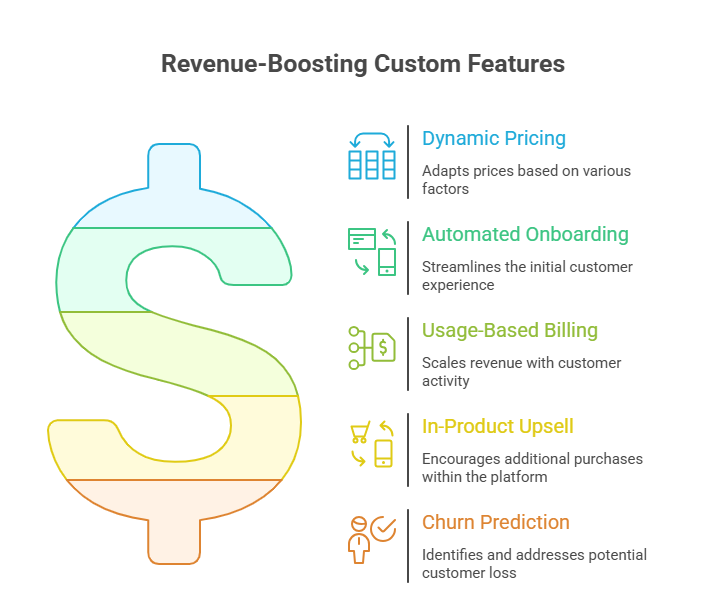
These aren’t “nice-to-have” features. They are revenue multipliers. When they live inside your own platform instead of someone else’s, the upside stays with you.
How does custom app architecture affect scalability, performance, and the marginal cost of growth?
Because architecture determines whether growth makes you richer or just busier. A scalable custom platform lowers the cost of each additional customer, while a fragile one forces you to keep hiring to keep up.
This is where most ROI models quietly fall apart. You can automate workflows and monetize features, but if the underlying architecture can’t scale cleanly, every spike in volume shows up as outages, performance tuning, and emergency engineering.
That’s not growth. That’s drag.
When your platform is designed around stateless services, shared data models, and elastic infrastructure, adding more customers doesn’t mean adding more complexity. It means more of the same transactions flowing through a system that was built to handle them.
That’s how companies grow from ten thousand to ten million users without their engineering budget exploding.
Why do cloud-native and API-driven architectures reduce cost per transaction as volume grows?
Because they let software do the scaling instead of people.
| What scales | Cloud-native & API-driven systems | Traditional architectures |
| Traffic | Auto-scales with demand | Needs manual capacity planning |
| Integrations | Reusable APIs | Custom point-to-point work |
| Deployments | Continuous | Risky, expensive releases |
| Failures | Isolated | Cascading outages |
| Cost per transaction | Goes down with volume | Goes up with complexity |
When the platform can scale itself, your marginal cost of growth drops. That’s when ROI stops being linear and starts compounding.
What operational efficiencies and cost reductions do enterprises typically achieve after deploying custom-built platforms?
They reduce the number of people required to move the same amount of work, while increasing accuracy and speed. That’s where the cost savings show up, not in software licenses but in how many humans you no longer need in the loop.
In real organizations, most operational cost hides in handoffs. One team enters data, another validates it, a third fixes exceptions, and a fourth reports on it. Custom platforms collapse those layers.
When sales, fulfillment, finance, and support run on a shared system, information flows once and is reused everywhere. Errors drop because there are fewer places to make them. Cycle times shrink because no one is waiting for someone else to push a button.
The result is not “better IT.” It is fewer tickets, fewer escalations, and fewer hours spent cleaning up after the system.
That is how operating costs come down without cutting growth.
How do automation, data unification, and workflow orchestration reduce headcount dependency and error rates?
Here’s what actually changes inside the business:
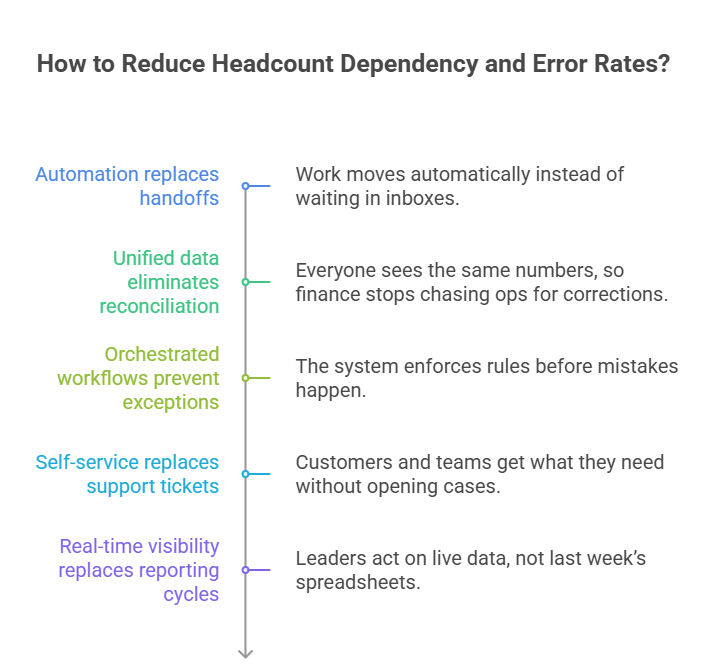
That’s why custom platforms don’t just save time. They remove entire layers of operational cost.
What real ROI have SaaS, FinTech, and Healthcare companies achieved from custom app development?
They’ve used custom platforms to increase revenue per customer, process more volume with the same teams, and remove the bottlenecks that SaaS stacks couldn’t fix. The ROI doesn’t come from “better software,” it comes from changing how money and work move through the business.
Here’s what that looks like in practice across industries:
| Industry | What They Replaced | What the Custom Platform Did | ROI Outcome |
| SaaS | Disconnected CRM, billing, and onboarding tools | Unified sales, provisioning, and billing | Faster time-to-revenue, higher conversion, lower churn |
| FinTech | Manual KYC, fraud, and transaction flows | Automated compliance and payment pipelines | Lower cost per transaction, higher approval rates |
| Healthcare | Fragmented patient, billing, and clinical systems | End-to-end patient and revenue workflows | Fewer errors, faster reimbursements, higher throughput |
In every case, the software didn’t just support the business. It became the business engine.
How have regulated industries used custom platforms to improve compliance, throughput, and profitability?
In regulated environments, SaaS rarely fits because rules change and risk tolerance is low. Custom platforms let organizations encode compliance directly into workflows instead of policing it after the fact.
I’ve seen healthcare providers automate patient intake, eligibility checks, billing codes, and audit trails so every action is validated before it moves forward. The same thing happens in FinTech with KYC, AML, and transaction limits.
The result is fewer rejected claims, fewer failed audits, and fewer people needed to manage exceptions. Throughput goes up because the system blocks bad data before it causes damage. Profitability improves because compliance stops being a cost center and starts being part of the operating model.
That’s what real ROI looks like in regulated businesses.
What are the real costs, timelines, and risks that determine whether a custom app delivers or destroys ROI?
ROI is decided less by what you build and more by how you run the delivery. Most failures come from scope drift, slow decision-making, and teams that aren’t aligned to business outcomes.
The real cost of a custom platform isn’t just engineering hours. It’s the time the business spends waiting for it. If product, engineering, and operations are not moving together, delivery stretches, requirements change, and ROI slips quarter by quarter.
The biggest risk I see is not technical failure. It’s governance failure: no clear owner, no measurable success criteria, and no mechanism to stop waste early.
When teams treat custom development like a capital project with milestones, metrics, and accountability, payback becomes predictable. When it’s treated like a feature factory, budgets disappear into endless rework.
That’s the line between ROI and regret.
What delivery models, team structures, and governance frameworks produce predictable ROI outcomes?
| What Works in Practice | Why It Protects ROI |
| Dedicated product owner with P&L visibility | Keeps build decisions tied to revenue and cost |
| Staff-augmented core team | Scales delivery without losing control |
| Quarterly outcome targets | Prevents scope creep |
| Incremental releases | Starts ROI before the full build is done |
| Technical + business steering group | Aligns engineering with strategy |
The companies that get ROI don’t just build software. They run it like a business.
How can a CTO or CFO estimate the ROI of a custom app project before approving the budget?
That’s why EdTech apps fail most often where teams skip backend depth or QA coverage, regardless of whether the work is done in-house or by an education app development company.
By modeling how much revenue moves faster and how much cost disappears once software replaces manual work. If you can’t express that in dollars per month, you shouldn’t approve the project.
When I build ROI cases, I ignore vague benefits and focus on three inputs: labor removed, revenue unlocked, and SaaS eliminated.
First, count how many hours are spent today on quoting, onboarding, billing, reporting, and support. Then price those hours. Next, look at deals lost or delayed because systems don’t connect. Finally, list the tools and integrations the custom platform would replace. That gives you a baseline.
If the combined savings and revenue lift cross the build cost within 18 to 24 months, the project makes economic sense. If not, it’s a nice idea, not a smart investment.
What would ROI look like for a $10M–$100M company investing in a custom platform to scale revenue and operations?
Let’s take a $50M SaaS business.
- 10 people spend half their time reconciling systems and fixing errors
- That’s roughly $600k a year in labor
- Add $300k in SaaS and integration tools
A $800k custom platform that eliminates most of that and speeds revenue by even 5% pays for itself in under two years. After that, every dollar of growth gets cheaper to serve.
Wrapping it Up
Leaders who get this right stop funding isolated tools and start funding systems that compound. They use ROI data from custom platforms to decide where to automate next, which products to scale, and where people can be replaced with software.
Over time, that creates a technology portfolio that gets more powerful as the business grows, instead of more expensive.
That’s the real digital transformation. Not migrating to the cloud. Not buying more tools. But deliberately investing in software that makes every future dollar of revenue easier to earn.
If software is one of your biggest investments, it should be modeled like one.
Start with a simple ROI framework to understand what a custom platform would change for your growth, costs, and execution speed.
In This Article
Frequently Asked Questions
Most mid-market and enterprise companies see break-even within 12 to 24 months when a custom app replaces manual work, multiple SaaS tools, or revenue bottlenecks. Payback depends on how much labor, licensing, and revenue friction the platform removes.
No. While SaaS looks cheaper upfront, it usually becomes more expensive over three to five years due to licensing growth, integrations, and operational overhead. Custom platforms have higher upfront cost but lower marginal cost as the business scales.
Companies with complex workflows, high transaction volume, regulated environments, or differentiated revenue models benefit the most. SaaS works for standard use cases; custom platforms win when operations become strategic.
They model labor saved, SaaS eliminated, and revenue unlocked, then calculate payback period, NPV, and IRR. If the combined gains exceed build and maintenance costs within two years, the investment is usually justified.
If the business is small, workflows are simple, and speed matters more than differentiation, SaaS makes sense. Once operations, pricing, or compliance become strategic, custom platforms deliver higher ROI
Blocked by Backlog or Missed Deadlines?
Senior developers who build, fix, and ship, without slowing your team down.