Build and Scale Faster
150+ products shipped for startups and enterprises by engineers focused on real outcomes.
"Their ability to quickly understand an unfamiliar use case and respond creatively to it is impressive."

Anonymous
Executive, Pured Disc Golf

"TechnBrains resolved challenges efficiently and turned my vision into a solid, functional product with a strong foundation."

Jalen Gibbs
Founder, STREAMLINE LIVE
"The talent they provided was solid, but more importantly, they were quick to align with our way of working."

Nancy Snyder
Managing Director, MimeCast
Our trusted clients


Start Your Product Journey Today
Turn your idea into a working product. Share a few details and we'll help define the roadmap, timeline, and execution approach.
8 Best Truck Fleet Management Software Platforms In 2026
Samsara is the best overall truck fleet management software for 2026, while Motive leads for trucking compliance and Fleetio stands out for maintenance. The right platform depends on your fleet size, primary cost problem, hardware setup, and need for tracking, safety, dispatch, or enterprise integrations.

Updated Aug 11, 2026
Truck fleet management software helps carriers manage vehicles, drivers, fuel, maintenance, safety, and FMCSA compliance from one system.
With truck operating costs reaching $2.336 per mile in 2025, fleets need tighter cost control. We selected one platform for each major need, including compliance, dispatch, safety, maintenance, fuel, small fleets, and enterprise operations.
This guide compares eight platforms for fleet managers, owner-operators, logistics leaders, and CTOs. Each option was reviewed using public product data, pricing, integrations, and independent reviews.
What Is Truck Fleet Management Software?
Truck fleet management software combines GPS location, engine and driver data, maintenance records, fuel data, and compliance logging into one system for managing a commercial truck fleet. It differs from three neighbors.
A transportation management system (TMS) plans and executes freight, loads, and settlements, sitting above the trucks. An ELD records hours of service; most platforms include one, but a standalone ELD manages neither maintenance nor dispatch.
A GPS platform shows location only, and fleet maintenance software handles work orders but usually leaves telematics to an integration.
How Did We Evaluate These Truck Fleet Management Platforms?
This is a public-evidence evaluation, not a hands-on lab test. We assessed each platform against official documentation, published and third-party-reported pricing, independent review sites (G2, Capterra, Gartner Peer Insights, app stores, Trustpilot, BBB), FMCSA sources, and ATRI’s 2026 cost report.
We then applied a production-readiness read from building logistics and dispatch software. Where sentiment is thin, split, or vendor-supplied, we say so, and vendor-reported results are labeled throughout.
We considered and excluded trucking-native TMS and accounting tools. They solve freight and settlement problems rather than vehicle and driver problems, and mixing the two categories makes a shortlist harder to act on.
What Are The 8 Best Truck Fleet Management Software Platforms In 2026?
The eight below cover distinct needs, from all-in-one operations to maintenance-only workflows. Match one to your primary problem and fleet size using the table above.
-
Samsara – Best Overall
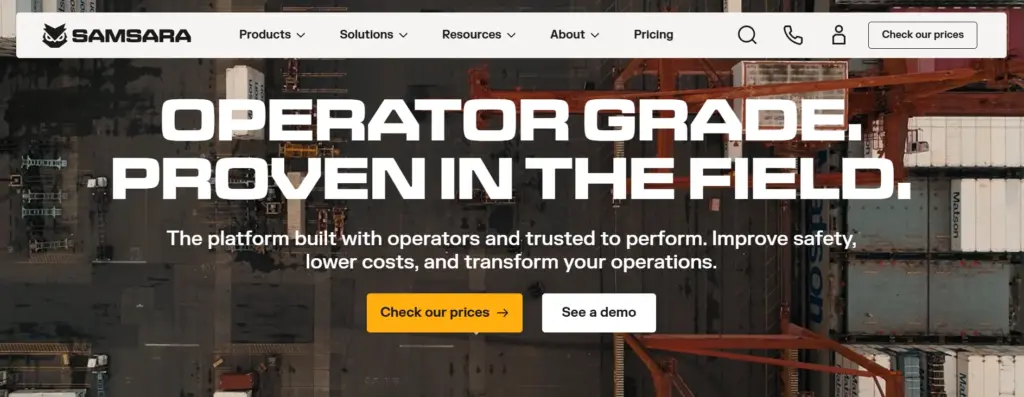 Industry fit: long-haul and regional trucking, construction, field service, food and beverage.
Samsara combines GPS tracking, AI dash cams, ELD and HOS compliance, diagnostics, routing, and maintenance in one platform. It crossed $2 billion in ARR in July 2026, reinforcing its position as one of the largest fleet technology vendors.
In 2026, Samsara also expanded beyond traditional telematics toward AI-driven operations. Its Agent Studio, launched in open beta at Beyond 2026, lets teams create safety and maintenance automations using pre-built templates and plain-language instructions.
Success: reviewers cite accident prevention and dashcam footage that clears drivers.
Failure: poor support (about 236 mentions) and technical issues (about 281), plus a three-year contract and per-vehicle price that climb with cameras.
Choose it if you want consolidation; avoid it if you have a few trucks and need only tracking and ELD.
-
Motive – Best For Trucking Compliance And Driver Safety
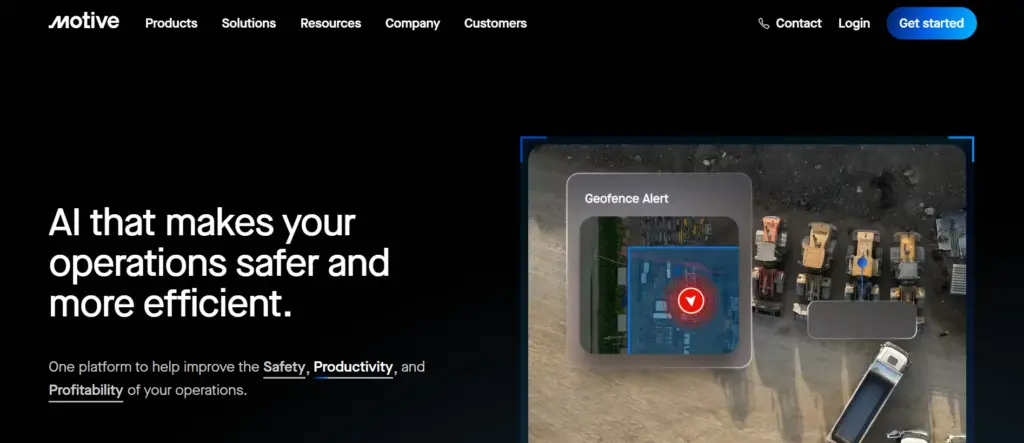 Industry fit: trucking, construction, oil and gas, food and beverage, and waste (industries Motive markets to directly). Built for US trucking as the KeepTruckin successor, its HOS, IFTA, DVIR, and DOT-inspection tools are among the category’s most mature, and its AI dashcam flags events a person reviews before a manager sees them.
Product and consumer sites disagree, and the reason matters. G2 (about 4.5) and Gartner Peer Insights skew positive on capability, though Gartner’s sample is small (about 19 ratings).
Trustpilot sits near the bottom of its business-services category, roughly 1.5 across about 2,000 reviews, dominated by billing, auto-renewal, and cancellation complaints; Capterra flags 36-month contracts.
Do not average them: read product sites for capability, consumer sites for the contract.
Choose it if compliance is non-negotiable, but read the contract closely; avoid it if you operate mainly outside North America.
-
Geotab – Best For Enterprise Data And Integrations
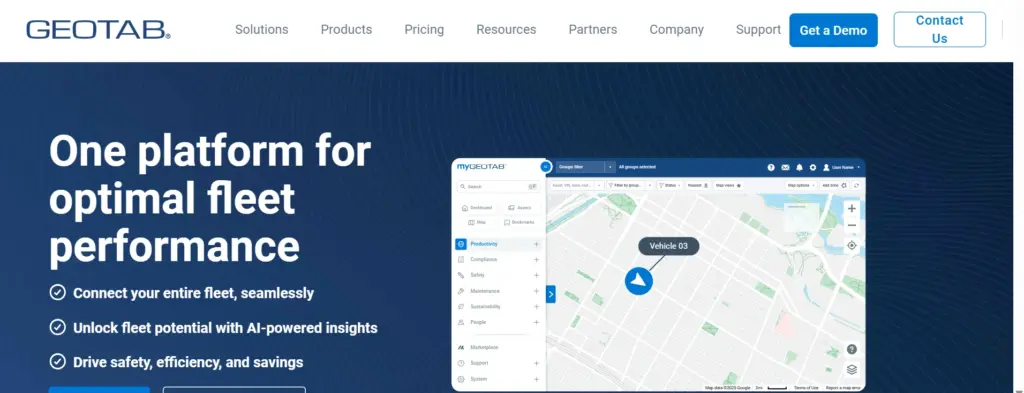 Industry fit: large enterprise and government fleets, and data-driven private distribution. Its edge is the open MyGeotab platform: hundreds of Marketplace integrations, a documented API, SOC 2 and FedRAMP, and scale across 160 countries.
Success: consistently among the best-reviewed telematics platforms, trusted by Fortune 500 and public-sector fleets.
Failure: the dashboard overwhelms beginners, resellers can price two buyers differently, and the Drive app sits near 3.8 on Google Play.
Choose it if you have technical resources to work its API; avoid it if you want a self-serve setup.
-
Verizon Connect – Best For GPS Tracking And Telematics
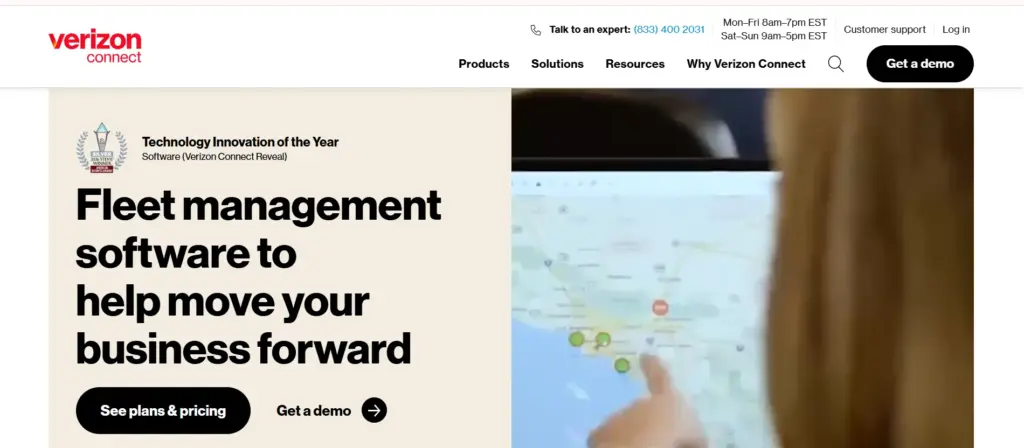 Verizon Connect combines the former Fleetmatics, Telogis, and Verizon Telematics into the Reveal platform, one of North America’s largest telematics providers. GPS tracking, driver safety scorecards, fuel reporting, and an FMCSA-registered ELD are proven, and carrier connectivity helps on long routes.
Success signal: customer Sonoco Recycling reported saving over $100,000 in fuel by cutting idle time (vendor-reported).
Failure signal: reviews repeatedly cite three-year contracts, pricing that climbs beyond the quote, and slow support.
Our verdict: the tracking is solid; the three-year commitment and true post-discount price are the real decision.
Choose it if you want a large, stable GPS provider. Avoid it if you need short-term flexibility.
-
Fleetio – Best For Fleet Maintenance
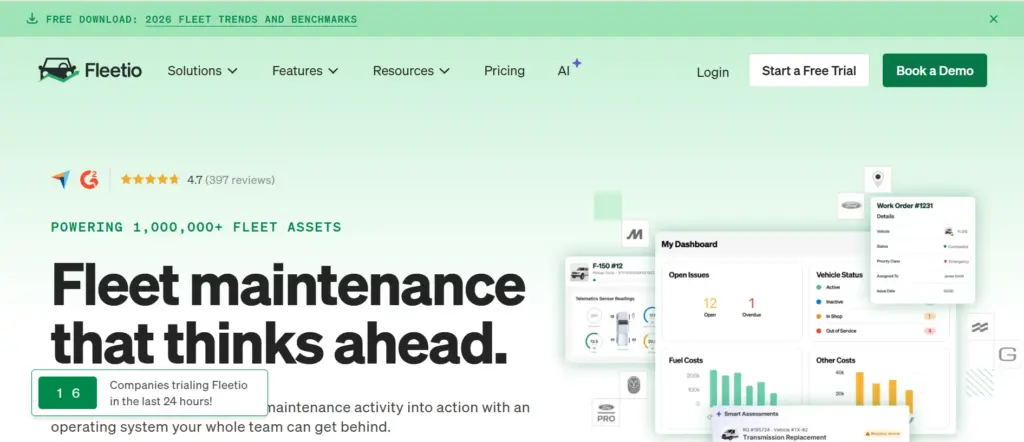 Industry fit: construction, private distribution, waste and recycling, and maintenance-heavy mixed fleets. Maintenance-first (work orders, preventive maintenance, parts, fuel, inspections, lifecycle cost), with no proprietary hardware and GPS integrations for Samsara, Geotab, and Motive.
Tiers are Essential $4, Professional $7, Premium $10 billed annually (Essential $5 monthly), five-vehicle minimum; pricing varies by fleet size and term.
Success: reviewers praise service reminders and total-cost-of-ownership visibility.
Failure: per-asset pricing can feel steep at scale, with occasional fees and app bugs. With repair and maintenance up 8.6% in ATRI’s 2026 data, a maintenance system of record often pays back faster than another GPS dot.
Choose it if downtime is your pain; avoid it if your first need is location.
-
Azuga – Best For Small Fleets
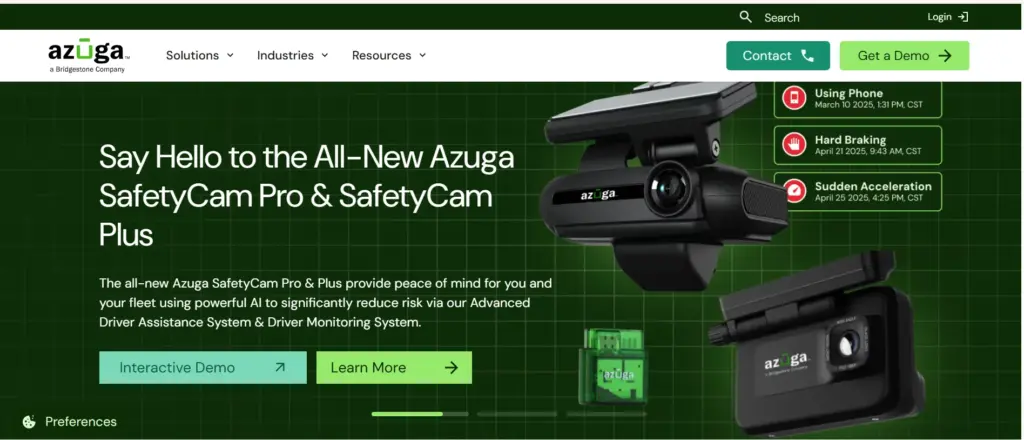 Industry fit: small regional carriers, last-mile delivery, and local service fleets. Its edge is gamified safety scoring that lets drivers compete for rewards, unlike the alert-heavy norm, alongside GPS, dash cams, diagnostics, maintenance alerts, and ELD support.
Success: about 65% of G2 reviewers are small businesses; Azuga case studies report large drops in citations and accidents (vendor-reported).
Failure: reviewers note privacy pushback, over-sensitive alerts, and occasional GPS inaccuracy.
Choose it if you run 5 to 50 mixed vehicles and want a scoring system crews adopt; avoid it if you need enterprise compliance.
-
Trimble Transportation – Best For Dispatch And Route Optimization
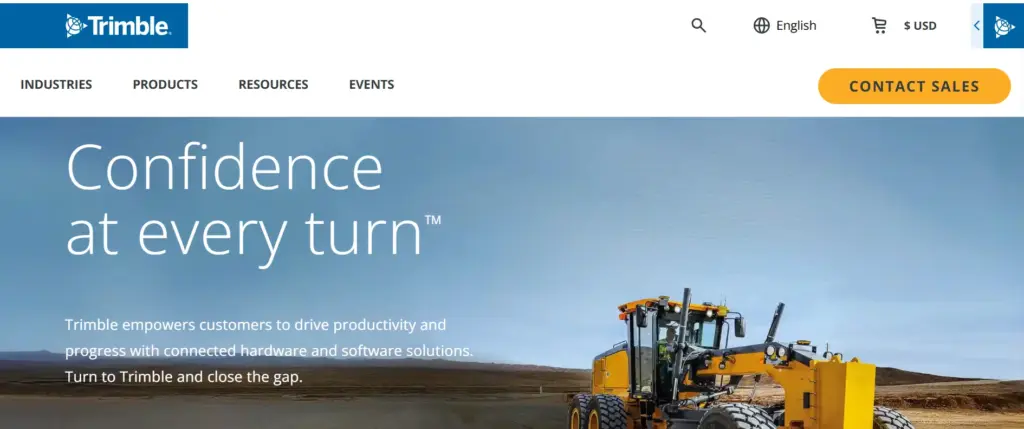 Industry fit: for-hire long-haul carriers, brokers, and refrigerated or multi-terminal operations. Its edge is a deep TMS suite (Innovative, TruckMate, TMW.Suite), PCMiler routing (the freight industry’s mileage standard), and TMT maintenance covering planning, dispatch, and settlements.
Ownership note: in February 2025 Platform Science completed its acquisition of Trimble’s global transportation telematics business, while Trimble kept its TMS; if you need both TMS and in-cab telematics, confirm which company supplies each module.
2026 watch point: Reports suggest Trimble may be exploring a sale of its Transportation and Logistics unit, although the company has not confirmed it. For buyers, the main concerns are product-roadmap continuity, integration support and data access. As I noted in a recent LinkedIn post, fleets should confirm data-export rights, integration dependencies and support commitments before signing a long-term agreement.
Success: long-tenured users praise scalability, DOT compliance, and PCMiler for complex operations.
Failure: an antiquated interface, slow support, and rollouts that run for months.
Choose it if freight execution is your core operation; avoid it if you mainly need GPS and ELD.
-
Omnitracs / Solera Fleet Solutions – Best For Large Specialized Carriers
 Industry fit: large long-haul carriers and specialized agriculture, oil and gas, and private fleets. Its edge is regulatory depth from decades of Qualcomm and SmartDrive heritage: HOS exemptions for agriculture, oilfield, and adverse driving, plus IFTA, CSA monitoring, and DOT audits.
Success: older analyst reviews report high recommendation rates for reporting depth across a large installed base.
Failure: recent sentiment is thin (G2 about 3.4 from about 28 reviews) and negative on a legacy interface, support delays, and billing; its BBB profile is poor.
Choose it if you run a large, regulation-heavy carrier and can verify fit with references your size; avoid it if you want a modern, self-serve platform.
Which Truck Fleet Management Software Is Best For Your Fleet Size?
Under 10 trucks, choose on contract length rather than monthly rate: Motive for compliance, Fleetio for maintenance. Between 10 and 50 trucks, Motive or Samsara. Above 50, Samsara or Geotab, or Trimble and Omnitracs when freight execution leads.
| Fleet size | Lead problem | First pick | Why |
| 1 to 10 | Compliance, cash flow | Motive, or Fleetio for maintenance | Shortest reported terms in this list |
| 10 to 50 | Safety exposure, downtime | Motive or Samsara | ELD plus AI dash cams, pilot before full rollout |
| 50+ | Dispatch, integrations | Samsara or Geotab; Trimble or Omnitracs if freight execution leads | API depth and multi-terminal reporting |
Under 10 trucks the binding constraint is contract length, not the monthly rate. Six trucks on a 36-month term at a reported $30 per vehicle commits roughly $6,480 before hardware, and Samsara’s terms make the full remaining balance due on early termination. The same six trucks on Motive’s reported 12-month minimum commit roughly $1,800. The monthly difference on six trucks is small in absolute dollars. The exit cost is not.
| Platform | Implementation | Hardware | Maintenance | Dispatch | AI |
| Samsara | Moderate | Proprietary | Strong | Moderate | Strong |
| Motive | Low | Proprietary | Moderate | Moderate | Strong |
| Geotab | Mod-high | Own/BYOH | Moderate | Moderate | Moderate |
| Verizon Connect | Moderate | Proprietary | Moderate | Moderate | Moderate |
| Fleetio | Low | None | Strong | Weak | Moderate |
| Azuga | Low | Proprietary | Moderate | Moderate | Moderate |
| Trimble | High | Mixed | Strong | Strong | Moderate |
| Omnitracs | High | Proprietary | Moderate | Strong | Moderate |
Which Platform Should You Switch To?
Switch only when the problem cannot be solved by changing the plan, reseller, hardware setup, or internal workflow.
| Switching from | Consider | Best reason to switch |
| Samsara | Motive | You want a more trucking-focused ELD and safety platform |
| Samsara | Geotab | You need greater API flexibility and reseller choice |
| Motive | Samsara | You want broader telematics, maintenance and operational tools |
| Motive | Geotab | You need an open ecosystem and more configuration options |
| Geotab | Samsara or Motive | You prefer a direct vendor relationship and simpler deployment |
Before leaving Geotab, determine whether the problem is the platform or the reseller. Changing resellers may cost less than migrating data, replacing hardware and reinstalling devices across the fleet.
Contract length should be verified through a written quote rather than used as the main reason to switch.
Which Platforms Handle Truck Driver Management and Compliance?
Motive and Samsara are the strongest starting points for U.S. trucking fleets that want ELD compliance, AI dashcams and driver coaching in one system. Both combine telematics data with video-based safety tools and driver workflows.
Azuga is better suited to smaller fleets that want driver scoring, rewards and gamification. Omnitracs remains relevant for established carriers that prioritize HOS, ELD and regulatory depth.
| Platform | Compliance setup | Confirm before signing |
| Samsara | Native ELD, HOS, DVIR and AI dashcams | Exact device, rulesets and CARB support |
| Motive | Vehicle Gateway ELD with AI dashcam integration | U.S. and Canadian coverage for the selected hardware |
| Geotab | GO device with Geotab Drive | Full HOS/ELD requires the GO Plan, not GO Core |
| Verizon Connect | Integrated ELD, HOS, DVIR and IFTA tools | Which features are included or sold as add-ons |
| Fleetio | ELD through a telematics integration | Which partner holds the ELD and compliance data |
| Azuga | ELD with driver scoring and rewards | Canadian certification for cross-border fleets |
| Platform Science | ELD, HOS and inspection tools | Contract and hardware changes for former Trimble customers |
| Omnitracs | ELD, HOS, IFTA and compliance tools | Supported exemptions and exact device model |
What Features Should Trucking Companies Prioritize?
Trucking companies should prioritize compliance, safety, and cost control before advanced features. The essentials are:
- An FMCSA-registered ELD with HOS, DVIR, and IFTA reporting
- GPS and telematics with diagnostics, fuel data, and driver monitoring
- Preventive maintenance with service schedules, fault alerts, and repair history
Then match features to your operation. Fleets with high accident exposure should prioritize dash cams and validated safety alerts. Multi-stop fleets need stronger dispatch and routing, while larger operations need APIs that connect with a TMS, ERP, fuel card, payroll, or accounting system.
Samsara CEO Sanjit Biswas described the company’s fiscal-2026 roadmap as using AI to surface insights and eventually automate workflows. That is the direction of the market, but usability still matters. A feature-rich platform will fail if dispatchers and drivers find it difficult to use.
Does Fleet Management Software Cover Customer Service?
Most fleet platforms do not, and neither does the TMS sitting above them. Both categories were specified around internal operations: planning, cost control, asset control, accounting, and compliance. Customer communication sits outside that feature set, and buyers usually notice the gap only after implementation.
Salih Cakir, co-founder of Alaka.ai, argues the omission is structural rather than a vendor oversight. TMS feature sets reflect what logistics and trucking companies asked for, and customer service was never high on that list.
“It is a systematic error, if you ask me.” What follows is a communication stream that stays reactive, where customer questions and document requests get attention once they have already escalated.
Expectations are moving the other way. Customers now want to be informed and even trained by their providers, and want carriers to act as solution partners rather than as regular service providers. Most companies hand that work to their operators, which he considers barely successful.
For buyers, this is a scoping question: check what your shortlist exposes to customers, and whether their updates depend on a dispatcher remembering to send them.
How Much Does Truck Fleet Management Software Cost?
Fleet management software or app costs around $20 to $60 per vehicle per month, excluding hardware and implementation. Most major providers use quote-based pricing, while Fleetio publishes plans from $4 to $10 per vehicle per month when billed annually. Additional costs may include:
- Hardware costing $99 to $500 or more per vehicle
- Installation and data migration
- Integrations and staff training
- Dash cams, routing, compliance modules, or premium support
- Cancellation and replacement fees
Request a written quote that separates software, hardware, installation, add-ons, contract length, renewals, and cancellation terms. The cheapest plan is not always the best value. A higher-priced platform may save more by reducing fuel waste, downtime, accidents, or disconnected tools.
How Should You Choose The Right Truck Fleet Management Platform?
Start with the operational problem costing your fleet the most, then check six things: existing hardware, ELD registration status, fleet complexity, contract terms, integrations, and vendor stability. Most rollouts fail on adoption, data quality, and unclear ownership rather than on missing features.
- Existing hardware: Choose a hardware-agnostic option if replacing current telematics would be costly.
- Compliance: Confirm the ELD is FMCSA-registered, supports your HOS rules, and is not revoked.
- Fleet complexity: Small fleets may need tracking, maintenance, and safety. Large carriers may require dispatch, settlements, APIs, and multi-terminal reporting.
- Contract terms: Review contract length, renewal rules, cancellation fees, hardware ownership, and post-discount pricing.
- Integrations: Confirm compatibility with your TMS, ERP, accounting, fuel, maintenance, and payroll systems.
- Vendor stability: Review recent acquisitions, ownership changes, product commitments, and support responsibilities.
The failure modes to plan against are inaccurate vehicle or maintenance data, weak TMS, payroll, fuel, or accounting integrations, limited staff training, and no internal rollout owner. Another mistake is automating a broken workflow, where software speeds up an inefficient process without solving it. Set measurable goals before implementation, such as reducing idle time, downtime, accident rates, compliance issues, or dispatch delays.
Shortlist two or three vendors and run a pilot. Measure driver adoption, alert quality, reporting accuracy, integrations, and support before rolling it out fleet-wide.
When Does Custom Fleet Software Make More Sense?
Custom software makes sense for fleet management when a platform forces your operation to work its way, and the gap sits in a workflow that differentiates you: proprietary dispatch or settlement logic no vendor models, deep integrations the platform will not support, data you need to own outright, or compliance beyond standard HOS and IFTA.
Where off-the-shelf breaks down.
Buyer complaints across review sites and forums are consistent. Standard platforms encode the vendor’s assumptions, so teams adapt to the software rather than the reverse.
When a platform will not integrate cleanly, staff re-key GPS, fuel, HOS, and settlement data across separate systems, and broken telematics-to-accounting connections are common. Per-vehicle fees compound as modules stack up and growing fleets outgrow pricing tiers, while your routes and customer data stay in the vendor’s infrastructure under its terms.
How TechnBrains Built a Custom Fleet Platform for Lulo Freight
Lulo Freight, a Texas-based logistics technology company, needed quoting, tracking, load boards, carrier workflows, settlements, and fleet management in one owned platform. Off-the-shelf fleet software could not support a two-sided marketplace model, so the workflow had to be built.
After a previous development partner failed to deliver the required scope, TechnBrains audited the existing build, identified technical and workflow gaps, and completed the platform around shipper and carrier needs. Delivered modules included instant freight pricing, real-time shipment tracking, a carrier load board, load and capacity management, driver and fleet management, payments and settlements, and role-based access.
For shippers, the platform improved quoting and shipment visibility. For carriers, it supported load management, capacity use, and fewer dead miles.
Want Similar Results for Your Fleet?
Every logistics business operates differently. We help transportation companies build software that fits their workflows instead of forcing teams to adapt to generic platforms.
See How We Build Logistics SoftwareFinal Verdict
There is no single best truck fleet management software, only the best fit for your primary problem. Samsara is the strongest all-round platform for mid-to-large mixed fleets, and Motive is sharper for US trucking where compliance and safety lead, provided you scrutinize the contract.
Geotab wins for enterprise data, Verizon Connect for established GPS, Trimble for dispatch and routing, and Fleetio for maintenance as the only transparently priced option here. Azuga fits small fleets wanting adoption-friendly safety, and Omnitracs suits large, regulation-heavy carriers that verify fit with references. Decide by problem and size, then pilot before you commit.
Table of Contents
Frequently Asked Questions
Samsara is the best all-round platform for mixed truck fleets, combining telematics, AI dash cams, maintenance, and compliance. For US trucking compliance and driver safety specifically, Motive leads. Match the platform to your fleet size and primary problem, not to a feature count.
Most platforms run roughly $20 to $60 per vehicle per month for software, plus hardware that can add $99 to $500 or more, and many require multi-year contracts. Fleetio is the transparent exception at $5 per vehicle per month. Get an itemized written quote before comparing.
Yes. Small fleets are well served by platforms built for their scale, such as Azuga for gamified safety or Fleetio for maintenance. Prioritize a short contract, simple onboarding, and a mobile app drivers will actually adopt.
Fleet management software runs the vehicles and drivers: tracking, maintenance, ELD compliance, and safety. A TMS runs the freight: load planning, tendering, carrier management, and settlements. Large carriers often use both, and platforms like Trimble and Omnitracs span both.
Yes. Most platforms include an FMCSA-registered ELD that automates hours-of-service logging, plus IFTA reporting and digital DVIRs. Before buying, confirm the device is registered and not on the FMCSA revoked list, since a decertified ELD leaves a 60-day window before drivers face out-of-service orders.
Trimble, because its TMS depth covers multi-terminal and reefer operations alongside PCMiler routing. Samsara suits reefer fleets that want temperature monitoring inside the same platform as tracking and compliance. Confirm sensor support for your trailer type before signing.
Not exactly. Truck management software may include dispatch, quoting and invoicing, while truck fleet management software focuses on GPS, maintenance, fuel, diagnostics and compliance.
Need Software Built Around Your Fleet?
We build custom logistics software around the workflows that make your operation different.