Build and Scale Faster
150+ products shipped for startups and enterprises by engineers focused on real outcomes.
"Their ability to quickly understand an unfamiliar use case and respond creatively to it is impressive."

Anonymous
Executive, Pured Disc Golf

"TechnBrains resolved challenges efficiently and turned my vision into a solid, functional product with a strong foundation."

Jalen Gibbs
Founder, STREAMLINE LIVE
"The talent they provided was solid, but more importantly, they were quick to align with our way of working."

Nancy Snyder
Managing Director, MimeCast
Our trusted clients


Start Your Product Journey Today
Turn your idea into a working product. Share a few details and we'll help define the roadmap, timeline, and execution approach.
How Much Does it Cost to Maintain an App
You have successfully launched your app and celebrated its success by putting app monetization strategies into action, enjoying the excitement of seeing your idea become real. However, as time goes by, the initial thrill fades, and you face an important reality: App Maintenance Cost. You must now manage updates, fix bugs, optimize performance, and add new features. With proper maintenance,...


Updated Nov 19, 2024
You have successfully launched your app and celebrated its success by putting app monetization strategies into action, enjoying the excitement of seeing your idea become real. However, as time goes by, the initial thrill fades, and you face an important reality: App Maintenance Cost. You must now manage updates, fix bugs, optimize performance, and add new features. With proper maintenance, your app can stay updated, active, and relevant, which can lead to fewer users, negative reviews, and loss of revenue.
Questions like “How much does app maintenance cost?” or “What factors affect mobile app maintenance costs?” are not just overwhelming—they can also lead to poor budgeting. App owners often struggle with unexpected maintenance costs. Just like we discussed in AI App Development Cost, business owners might not understand why some apps cost more to maintain or why certain updates use up more of their budget. This confusion can lead businesses to either spend too little on maintenance or set their budgets too high, which isn’t good for long-term growth.
This blog will explain the different factors that affect the cost of maintaining an app. We will provide tips on how to plan for these costs to avoid surprises. By breaking down the costs of app maintenance, you’ll understand why some tasks are more expensive and how to manage costs effectively. You’ll also learn about the types of app maintenance and the long-term benefits of investing in-app updates.
How Much Does App Maintenance Cost?
The average cost to maintain an app is about 15% to 20% of what it originally cost to develop. The app maintenance cost is influenced by several key factors, such as the app’s complexity, the technology used, and the region where the app is being developed or maintained. Typically, app maintenance costs per year is approximately $2,000 to $2,500 each month at the start to maintain the app’s optimal performance.
Why Is App Maintenance Important?
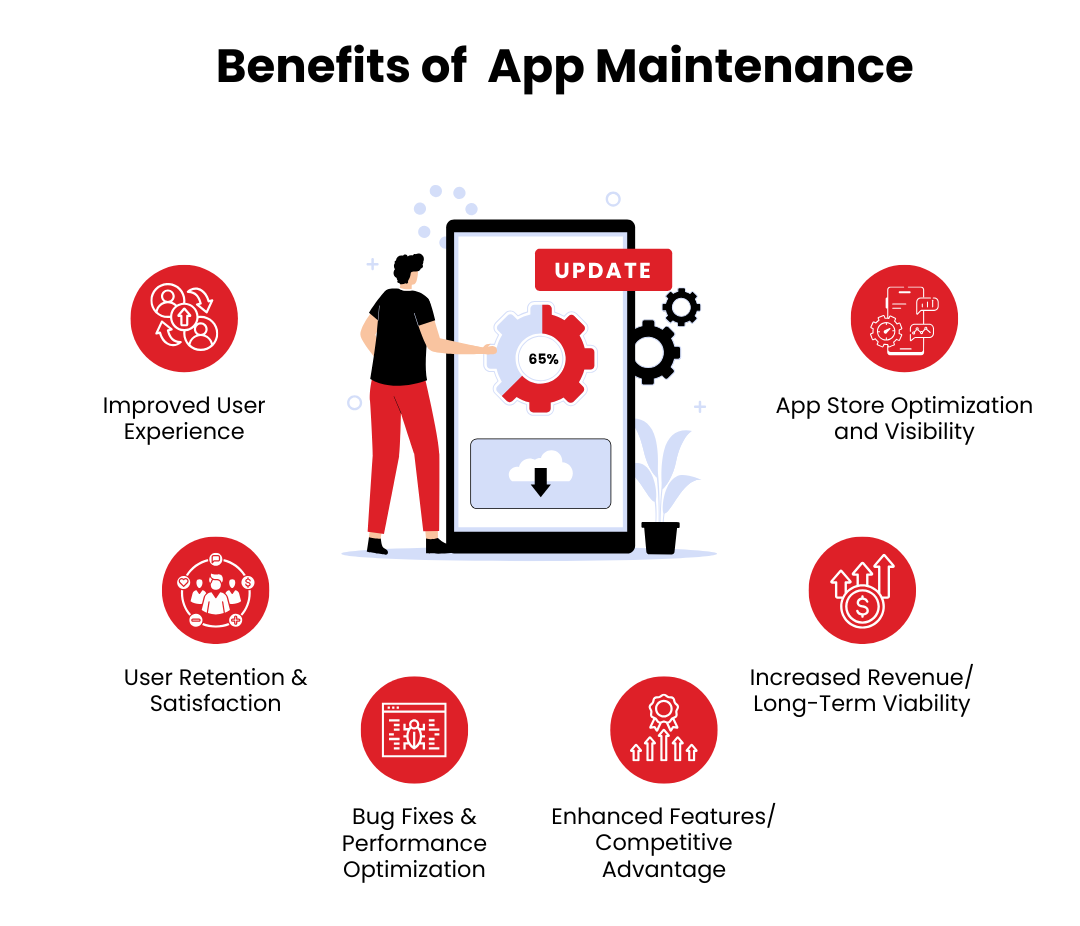
As a business owner or startups, we understand the importance of maintenance applications, but we may overlook the extensive benefits they offer. Here’s a more in-depth look at why app maintenance is a crucial investment for any app owner or business:
Improved User Experience
One of the most important reasons for regular app maintenance is to enhance the user experience (UX). Regular updates are key to ensuring the app continues to function seamlessly and that users remain satisfied. Factoring in application development and maintenance as part of the process ensures smooth functionality and user satisfaction.
Bug Fixes & Performance Optimization
Frequent maintenance allows for identifying and correcting bugs that might degrade the user experience. Small errors, whether visual glitches or functionality issues, can frustrate users, leading them to abandon the app. Regular updates help control the App Maintenance Cost, preventing expensive overhauls.
Smooth Functionality Across Devices
As new devices and operating systems (OS) are released, your app needs to stay compatible. Regular maintenance ensures your app performs well on the latest smartphones, tablets, or wearables. Managing App Maintenance Costs proactively ensures your app stays relevant and functional.
Enhanced Features
By introducing new features continuously, you keep the app fresh and exciting for users. Whether it’s new functionality or improving an existing feature, these updates maintain user engagement. While these improvements may increase the costs of maintaining an app, the enhanced user experience justifies the investment.
Faster Load Times & Optimized Performance
Performance optimization, such as reducing app load times and enhancing speed, directly influences user perception. A faster app keeps users happy and engaged. Considering app maintenance Costs here as an investment in user satisfaction can lead to long-term gains.
User Retention & Satisfaction
Consistently improving the app’s performance and resolving issues builds trust. A well-maintained app attracts positive reviews and retains users effectively. The recurring App Maintenance Cost ensures users keep returning, fostering loyalty and growth.
Increased Revenue
Many apps rely on in-app purchases (IAP) for revenue generation. Regular updates that add new, desirable features encourage users to spend more on your app. Allocating resources to App Maintenance Costs for feature enhancements drives revenue growth.
Subscription Retention
Apps with subscription-based models thrive on user retention. Continuous updates keep users engaged, reducing churn, and ensuring renewals. The App Maintenance Cost becomes a necessary investment for maintaining a steady subscription revenue stream.
Ad Revenue Growth
Better app engagement leads to higher ad revenue. Updated apps with fresh content and bug fixes encourage users to interact with ads more. While these updates involve App Maintenance Cost, the resulting ad revenue increase often outweighs the expense.
App Store Visibility
Apps that release consistent updates are favored by app stores like Google Play and the Apple App Store. Reliable, well-maintained apps rank higher, leading to more downloads and visibility. Investing in App Maintenance Cost enhances your app’s reputation and ranking.
Competitive Advantage
Regular maintenance keeps your app evolving, outperforming stagnant competitors. Innovative features and consistent improvements attract new users and maintain existing ones. Though this increases the App Maintenance Cost, staying competitive demands continuous investment.
Cost Savings
Regular maintenance ensures your app remains relevant, adaptable, and competitive. Apps left stagnant lose users to newer solutions. Proactive maintenance avoids the higher App Maintenance Cost of complete overhauls.
Preventing Major Issues
Addressing minor bugs early avoids costly emergency fixes. Neglecting maintenance allows small issues to escalate, leading to significant expenses. Keeping App Maintenance Cost low requires consistent, preventive measures.
Avoiding Downtime
An app with frequent crashes or downtime frustrates users and loses revenue. Ongoing maintenance minimizes downtime, ensuring consistent performance. Factoring in App Maintenance Cost helps reduce potential losses from unavailability.
Security Patches
Regular maintenance keeps your app protected with updated security protocols and vulnerability patches. It’s more cost-effective to include these updates as part of App Maintenance Cost than to recover from a data breach.
Long-Term Viability
Continuous updates keep your app relevant and valuable over time. Neglecting maintenance results in outdated apps requiring complete redevelopment. Maintaining regular App Maintenance Cost ensures your app adapts to market needs without significant investments later.
What factors affect mobile app maintenance costs?
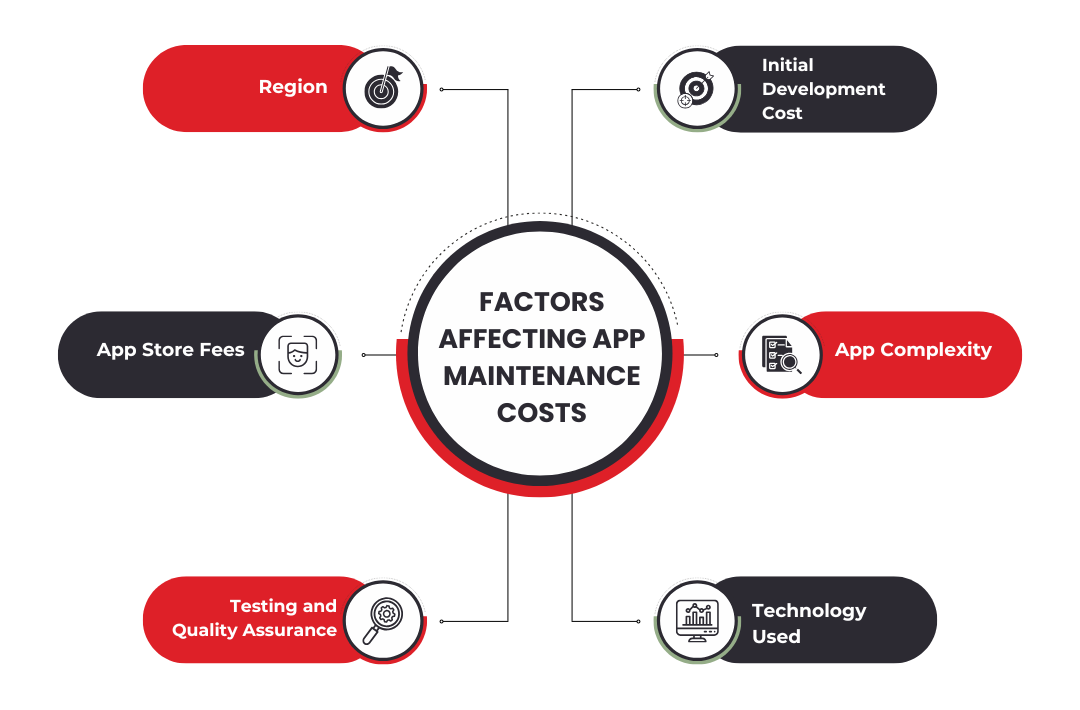
As discussed above, there are many factors contributing to the App Maintenance Cost. Let us breakdown each of the factors in detail to have a better understating of App Maintenance Cost:
Initial Development Cost
The initial development cost refers to the expense incurred when the app is first created. This includes the design, coding, testing, and deployment of the app. Once the app is launched, maintenance costs are typically calculated as a percentage of this initial cost.
First-Year Maintenance Costs
In the first year after launch, app maintenance can reach up to 50% of the initial development cost. This is the period when most app owners face the largest costs, as updates, bug fixes, and performance optimizations are required to ensure the app performs well in real-world scenarios. Also, user feedback often results in necessary updates that weren’t initially planned.
Ongoing Maintenance Costs
After the first year, the costs typically drop to 15-20% of the original development cost per year. This reflects a more stable phase of app maintenance where minor updates, bug fixes, and security patches are needed.
App Complexity
The more complex your app is, the more expensive it will be to maintain. Complexity can refer to the following factors:
- Number of Features: Apps with multiple features (e.g., user profiles, payment processing, real-time interactions) will require more ongoing work.
- App Functionality: Apps that depend on third-party integrations, cloud services, or complicated databases tend to have higher maintenance costs.
- Security: More complex apps, especially those dealing with sensitive data (e.g., financial apps, healthcare apps), will require frequent security updates to stay compliant with industry standards and to protect against new vulnerabilities.
- Cost Estimate: For complex apps, the maintenance cost may reach 25-30% of the initial development cost annually. Complex apps need more resources to ensure they remain secure, efficient, and feature-rich over time.
Technology Used
The technology that your app is built on can significantly impact application development maintenance costs. Apps that rely on cutting-edge technologies or have multiple integration points (e.g., payment systems, third-party APIs, or AI features) will require more frequent updates to stay aligned with new developments. As technology evolves, you may need to update your app to accommodate the latest trends, ensuring your app remains relevant and competitive.
Region
Where your app is maintained also plays a significant role in determining costs. App maintenance rates vary depending on the region:
- North America and Western Europe: These regions generally have the highest rates due to higher labor costs and the need for skilled developers.
- Eastern Europe and Asia: These regions tend to offer more affordable rates due to lower labor costs, making them attractive options for outsourcing app maintenance.
- Cost Estimate: Maintenance costs in North America can be up to 40% higher than in regions like Eastern Europe or India, where hourly rates for developers are lower.
| Maintenance Task | Estimated Monthly Cost |
|---|---|
| Bug Fixes | $500 – $1,500 |
| App Updates (OS and Feature) | $1,000 – $3,000 |
| Security Updates | $500 – $2,000 |
| Backend Server Maintenance | $1,000 – $5,000 |
| User Support and Feedback Handling | $500 – $2,000 |
| Performance Optimization | $1,000 – $3,000 |
The costs above are approximate and depend on the complexity of your app, the type of maintenance required, and the geographical location of your development team.
Other Factors Affecting App Maintenance Costs
App maintenance cost is influenced by several additional factors beyond regular updates and bug fixes. For instance, server costs are a recurring expense as you maintain, upgrade, or scale servers to ensure fast load times and reliability for growing user bases. Push notifications, often facilitated through third-party services, can add up in cost, especially with frequent usage.
Similarly, apps that process payments incur expenses for transaction fees and periodic updates to maintain secure payment integrations. Hosting fees are another significant factor, particularly for apps with substantial data needs, and choosing scalable hosting solutions can help optimize costs.
App Store Fees
App store fees are another recurring expense, as platforms like the Apple App Store and Google Play Store charge developers to maintain apps and ensure compliance with store guidelines. Providing customer support services also increases the app maintenance cost, especially if you allocate resources for live chat, email support, or a dedicated helpdesk. Additionally, apps leveraging third-party APIs for features like maps or analytics face usage-based pricing that can grow with user demand. Security updates and compliance with data protection laws like GDPR or CCPA require constant monitoring and may involve legal consultations, making them essential yet costly components of maintenance.
Testing and Quality Assurance
Other factors that affect app maintenance cost include regular testing and quality assurance to ensure compatibility with new devices and operating systems. Apps often rely on analytics and monitoring tools, which typically involve subscription fees. Additionally, marketing efforts such as retention campaigns and user engagement strategies indirectly contribute to costs but are crucial for sustained success. By understanding and accounting for these diverse factors, businesses can effectively plan and manage their application maintenance & support budget while ensuring a seamless user experience.
Proactive Budget Management
To better manage these additional expenses, it’s crucial to:
- Periodically review all ongoing and potential costs to avoid surprises.
- Choose solutions and infrastructure that can scale efficiently as your app grows.
- Allocate a portion of the budget for unexpected updates, such as compliance with new regulations or emergency bug fixes.
- For third-party services like hosting, APIs, or notification platforms, explore bulk discounts or cost-effective alternatives to reduce expenses.
By planning and addressing these factors proactively, you can keep app maintenance costs manageable while ensuring your app continues to perform optimally and deliver value to users.
Types of Mobile App Maintenance
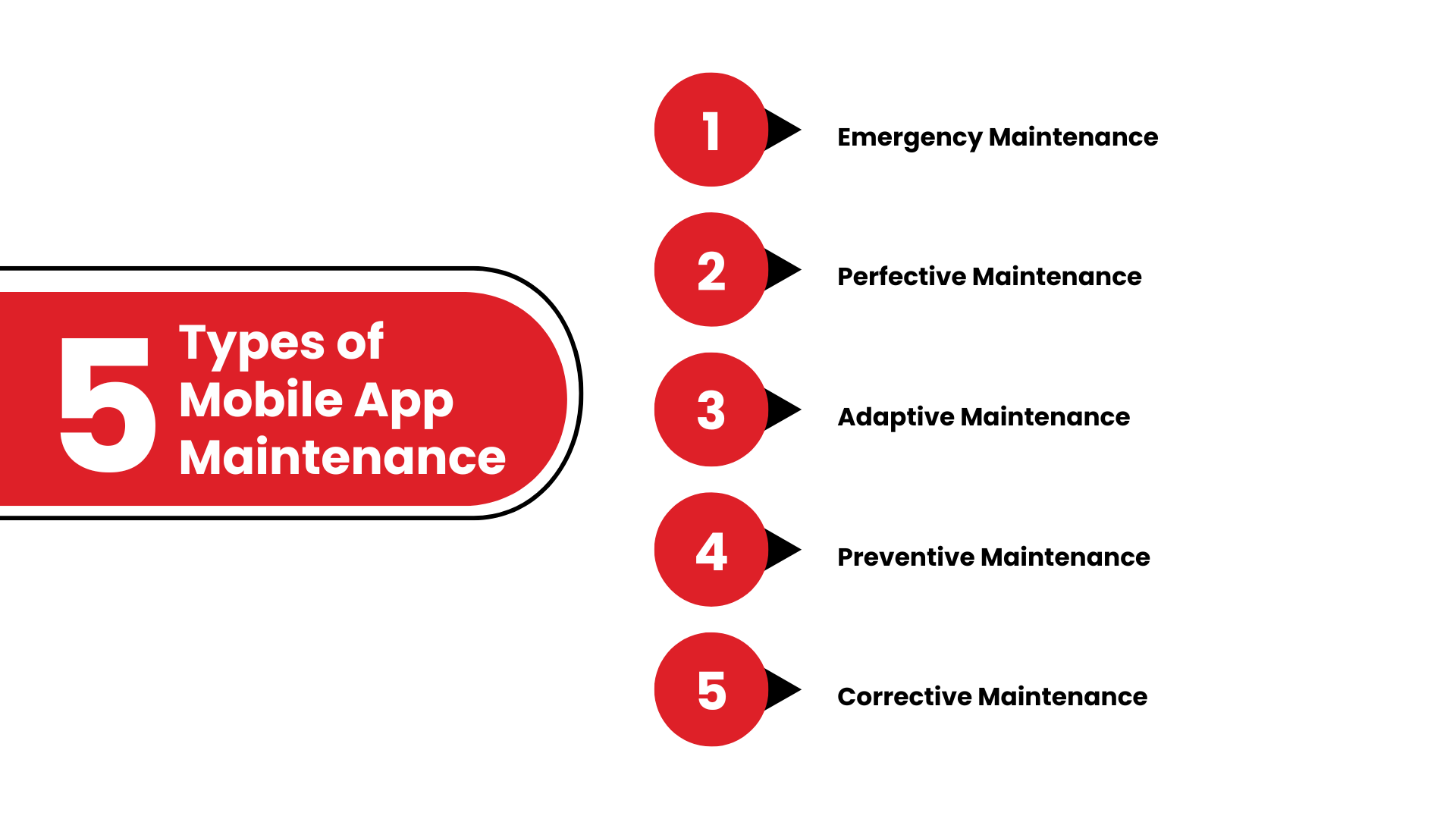
Yes you read that tight, there are types of app maintenance that can add to the overall App Maintenance Cost. Knowing the different types of app maintenance helps you decide how to allocate your resources for ongoing support effectively. Let’s take a closer look at each type of maintenance:
1. Emergency Maintenance
This type of maintenance is required to address critical issues that arise unexpectedly. For instance, if your app suddenly crashes or experiences a security breach, emergency maintenance becomes necessary. Here are some examples:
- Crashes: An app might crash upon launch, during certain actions, or when a user interacts with specific features. Emergency fixes are needed to ensure your users don’t face app failures, which could lead to uninstalls or negative reviews.
- Security Breaches: If your app is hacked or compromised, emergency fixes are necessary to patch up vulnerabilities and protect sensitive user data. Data leaks, especially those involving personal information, can lead to legal issues and a damaged reputation.
- Server Downtime: If the backend servers go down, emergency maintenance is needed to bring the app back online and avoid losing user trust.
The goal of emergency maintenance is to restore the app to full functionality as quickly as possible, minimizing disruptions to users and preventing long-term damage to your brand.
2. Perfective Maintenance
Perfective maintenance focuses on improving and enhancing the functionality of your app. This is typically driven by user feedback and evolving market trends. It may entail introducing new, appealing features can significantly enhance the user experience. For instance, implementing social sharing capabilities or integrating with other applications can create a more seamless interaction. Then we have UI/UX Improvements, as user expectations and design trends continuously evolve, it’s crucial to keep the user interface (UI) and user experience (UX) current and in line with these changes.
User Feedback Integration is actively listening to and integrating user feedback is key to ensuring your app remains relevant. When users request specific improvements or features, effective maintenance helps meet those needs promptly.T his type of maintenance makes sure your app stays competitive and engaging over time, improving user satisfaction and engagement.
3. Adaptive Maintenance
As new operating systems (OS), devices, or third-party integrations emerge, adaptive maintenance ensures your app remains compatible. Some tasks involved include:
- OS Updates: Every time Android or iOS releases an update, your app needs to be tested and updated to ensure it functions well on the new version. Without this, the app may malfunction or fail to open.
- New Device Compatibility: When new devices (such as phones or tablets) are released, the app should be tested to ensure it works on these devices, especially if the devices come with new screen sizes, processors, or features.
- Third-party Integrations: Many apps rely on external APIs or services (such as payment systems or data feeds). When these services update, your app may need adjustments to stay compatible.
Adaptive maintenance is necessary to make sure your app can evolve with technological changes and keep working seamlessly as the environment around it changes.
4. Preventive Maintenance
Preventive maintenance is about fixing problems before they happen. First, we have code refactoring. This means cleaning up the code to make it work better and easier to maintain later. This can help prevent slow performance or crashes caused by old or inefficient code. Next is Data Management. Regular checks on how the database runs and how storage is used keep your app performing well and able to grow.
Finally, there’s testing. Periodic testing of all app parts, including backend services and APIs, helps find weaknesses or potential performance issues. By stopping problems before they start, you save time, money, and resources that would be spent fixing issues after they affect users.
5. Corrective Maintenance
Corrective maintenance focuses on fixing bugs and addressing errors that users or developers have identified. These bugs may include:
- Functional Errors: Bugs that cause certain features or functions to break.
- UI Bugs: Small issues in the user interface, such as misaligned buttons, broken images, or text that doesn’t display correctly.
- Crash Fixes: If users are experiencing app crashes on specific devices or under certain conditions, corrective maintenance addresses those errors.
Corrective maintenance is about keeping the app error-free, ensuring a smooth and stable experience for users.

Wrapping it Up
App maintenance is not an afterthought—it’s an integral part of the app lifecycle. By investing in regular updates, fixing bugs promptly, optimizing performance, and adapting to changing technology, you ensure your app remains relevant, functional, and user-friendly. On average, app owners should expect to invest around $2,000 to $2,500 app maintenance cost per month initially to ensure their app operates at peak performance.
Understanding the cost of app maintenance and the various factors that impact it helps you prepare better, plan ahead, and allocate resources effectively. Remember, maintenance is an ongoing investment that directly affects your app’s user experience, security, and long-term success. By managing these costs wisely, you can continue to provide value to your users and enjoy the rewards of a thriving mobile app.
Why Choose TechnBrains for App Maintenance?
When it comes to managing app maintenance services, TechnBrains stands out as a reliable partner for all your needs. Whether you require comprehensive mobile app maintenance services or tailored solutions for application development and maintenance services, we have the expertise to ensure your app performs flawlessly.
As a leading application maintenance company, we offer a wide range of mobile application maintenance services, including server optimization, bug fixes, feature updates, and security enhancements. Our team specializes in crafting strategies that keep your mobile maintenance app compatible with the latest devices and operating systems, ensuring a seamless user experience.
Looking for an app for maintenance services that delivers both quality and affordability? At TechnBrains, we are the leading mobile app development company in Texas. We combine industry-leading practices with cutting-edge technology to help you manage your app efficiently and cost-effectively. Let us take care of your app’s needs so you can focus on growing your business. Connect with us today to explore how we can support your app maintenance goals!
In This Article

Blocked by Backlog or Missed Deadlines?
Senior developers who build, fix, and ship, without slowing your team down.