Build and Scale Faster
150+ products shipped for startups and enterprises by engineers focused on real outcomes.
"Their ability to quickly understand an unfamiliar use case and respond creatively to it is impressive."

Anonymous
Executive, Pured Disc Golf

"TechnBrains resolved challenges efficiently and turned my vision into a solid, functional product with a strong foundation."

Jalen Gibbs
Founder, STREAMLINE LIVE
"The talent they provided was solid, but more importantly, they were quick to align with our way of working."

Nancy Snyder
Managing Director, MimeCast
Our trusted clients


Start Your Product Journey Today
Turn your idea into a working product. Share a few details and we'll help define the roadmap, timeline, and execution approach.
How to Choose Android App Development Services for Startups
In 2026, the global mobile app market is projected to generate over $613 billion in revenue, underscoring how mission-critical apps are to modern business growth. Yet amidst this explosion, 70% of app projects still fail before launch due to misaligned expectations and execution risks, and that failure often stems from the very partner you choose. From what I’ve seen working...

Updated Jul 09, 2026
In 2026, the global mobile app market is projected to generate over $613 billion in revenue, underscoring how mission-critical apps are to modern business growth.
Yet amidst this explosion, 70% of app projects still fail before launch due to misaligned expectations and execution risks, and that failure often stems from the very partner you choose.
From what I’ve seen working with early-stage and scaling teams, most Android app failures don’t come from weak ideas.
They come from early decisions around development partners, engagement models, and architecture that don’t hold up once users, features, and compliance requirements grow.
Choosing Android app development services as a startup is about managing cost, scalability, ownership, and technical risk before they become expensive constraints.
This guide breaks down how to evaluate those trade-offs clearly.
Key Takeaways
- Choosing Android app development services as a startup is a risk management decision, not a vendor comparison.
- Early mistakes in architecture, engagement model, or ownership compound quickly once users, data, and compliance enter the system.
- In 2026, realistic Android outsourcing budgets range from $50k–$120k for scalable MVPs and $120k–$250k+ for production V1 builds.
- Dedicated teams or staff augmentation outperform fixed-price models when requirements evolve after launch.
- Scalable Android teams rely on modular architecture, CI/CD, automated testing, and clear ownership boundaries.
- Founders should evaluate partners on long-term velocity, exit readiness, and governance, not just delivery speed.
Why Android App Development Decisions Are Different for Startups
Because startups don’t get a second chance to fix early Android decisions once users, data, and investors are in the system.
In practice, Android app development for startups is constrained by runway, not ambition. Every choice around architecture, team composition, and delivery model either preserves flexibility or creates future drag.
Unlike enterprises, startups cannot absorb rewrites caused by poor modularization, weak ownership boundaries, or partners optimizing for short-term delivery over long-term maintainability.
As of 2026, Android powers over 72% of the global mobile OS market, making it the primary surface where startups test demand, pricing, and retention at scale.
That reach is valuable, but it also exposes weak execution faster. Bugs, performance issues, and scalability gaps surface early when distribution is wide.
This is why Android development decisions for startups are operational decisions, not platform preferences.
Startup constraints: budget, speed, hiring gaps
Startups choose Android partners under constraints that directly shape technical outcomes.
Most early-stage teams lack senior Android engineers, stable DevOps pipelines, and time to experiment. Budgets are milestone-driven, timelines are investor-facing, and hiring is slower than delivery needs.
This reality pushes startups toward outsourcing or staff augmentation, but only models that allow rapid iteration, clear ownership, and controlled scaling actually work.
Checklist I use when assessing startup readiness:
- Budget tied to runway, not annual planning
- Delivery deadlines aligned to funding or launch events
- Limited in-house Android architecture expertise
- Need to scale engineers up or down quickly
- Zero tolerance for vendor lock-in
Why Android remains the default for startup MVPs
Android is chosen for MVPs because it exposes product weaknesses faster, not because it’s cheaper.
Google Play’s distribution scale, staged rollouts, and rapid update cycles allow startups to validate demand across diverse user segments quickly.
Kotlin’s maturity and Android’s standardized tooling reduce accidental complexity early, which matters when teams are small and changes are frequent.
For MVPs, Android offers the fastest path to real usage signals without committing to parallel platforms too early.
How Should Startups Evaluate Android App Development Services?
Startups must evaluate Android app development services or hire android developers on three criteria, cost vs scalability vs speed, code ownership/IP control, and partner signals, because these directly determine velocity, risk, and future product value.
Modern software delivery performance consistently shows that high-performing teams optimize both delivery stability and improvement velocity rather than just speed.
That makes evaluation frameworks mission-critical. A partner’s ability to balance cost, speed, and future growth is the difference between an MVP that stalls and a product that scales.
Cost vs speed vs scalability trade-offs
If you optimize only for cost or speed, you increase technical debt and long-term delivery costs.
According to Stack Overflow, developers increasingly report complex ecosystems and toolchains requiring deep internal familiarity for long-term velocity.
Teams that prioritize scalable architecture from day one spend up to 33% less on maintenance and rework over the first 18 months. Speed and budget alone don’t deliver this outcome.
Operational reality comparison:
| Priority Optimized | Outcome (0–3 months) | Risk (6–18 months) |
| Cost-first | Minimum spend | High rework burden |
| Speed-first | Fast delivery | Fragile code, regressions |
| Scalability-aware | Balanced start | Lower total ownership cost |
Teams that align architecture planning with delivery reduce refactor slippage and hiring friction.
Code ownership, IP control, and long-term velocity
Without full control over your Android codebase and pipelines, your product velocity slows with every release.
Codebase complexity and vendor-locked repos are key factors delaying feature delivery. This is operational drag.
Risk box — real red flags to watch:
- Vendor retains build or deployment ownership
- No written API/module boundaries
- Sparse or absent automated tests
- Docs optimized for the vendor, not your team
- Lack of integration with your CI/CD pipelines
Signals of a startup-ready Android partner
A partner is startup-ready when they demonstrate architecture foresight, flexible resourcing, and outcome-based delivery, not just task execution.
Key signals backed by industry patterns:
- Modular Android architecture with clear boundaries
- Senior engineers in planning (not just execution)
- Sprint metrics tied to quality and adoption (not hours)
- Flexible team sizing without excessive contract penalties
- Roadmap-aligned tech decisions vs narrow ticket fulfillment
Evidence from software delivery research shows that teams emphasizing adaptability outperform rigid, plan-only teams by 2.3x in feature throughput.
Planning to outsource Android app development in 2026?
Before you sign, validate your architecture, engagement model, and risk exposure with engineers who’ve scaled startup Android products before. No pitches. No commitments. Just clarity
Cost-Effective Android App Outsourcing for Startups: What’s Realistic?
For 2026 planning, a realistic outsourced Android app build for startups ranges broadly from $25,000 for a focused MVP to $250,000+ for a scalable, feature-rich product, and costs depend directly on complexity, team model, and delivery quality.
Outsourcing is about where those costs land you in terms of quality, velocity, and future maintenance. Cutting corners on architecture or QA to hit the lowest number almost always leads to rework budget blowouts later.
MVP, V1, and scale-stage cost ranges
Android budgets vary significantly by stage, like basic MVPs start lower, but realistic builds with production-grade architecture hit mid-six figures.
| Stage | Typical Cost Range (Outsourced) | What You Get | Reality Check |
| MVP (core value only) | $25,000 – $75,000 | Basic flows, limited backend, minimal polish | Often needs refactor for scale |
| V1 (production readiness) | $80,000 – $200,000 | Well-structured architecture, CI/CD, moderate features | Best value for external teams |
| Scale-stage (feature set + analytics + integrations) | $200,000 – $400,000+ | Advanced UX, analytics, performance, security | Enterprise-grade expectations |
These are baseline realities, not agency pitch numbers. True costs depend on backend complexity, integrations, security, and platform readiness.
Hidden costs startups usually miss
Startups routinely underestimate ancillary development costs that exceed initial build estimates by 20–40%.
Hidden costs warning box:
- Ongoing maintenance & OS updates (often 15–25% of initial spend annually)
- QA & regression testing across Android device diversity
- Backend hosting, cloud services, CDN & monitoring
- Security compliance (GDPR, PCI, HIPAA)
- App Store fees & certification cycles
These can quietly double your budget if not planned upfront.
Timeline expectations under $50k–$200k budgets
Typical delivery timelines under outsourced budgets fall into predictable bands:
- $25k–$50k: ~3–4 months (core MVP, limited QA)
- $50k–$120k: ~4–6 months (production-ready, solid QA)
- $120k–$200k: ~6–9+ months (moderate complexity + integrations)
Expect complexity, third-party APIs, compliance requirements, and UX polish to push timelines toward the higher end.
How to Choose the Right Engagement Model for Startup Android Projects
The engagement model you choose, like fixed-price, dedicated team, or staff augmentation, should be based on how dynamic, uncertain, and long-term your Android product requirements are, because these models trade off predictability, control, and scalability in fundamentally different ways.
Flexible engagement models like staff augmentation and dedicated teams now account for over 60% of outsourced software engagements as companies seek both cost control and adaptability in product development.
A startup’s choice here influences velocity, future hiring, and technical debt, not just cost.
Fixed-price vs dedicated team vs staff augmentation
Fixed-price suits well-defined scope and short bursts; Dedicated teams fit evolving, long-term products; Staff augmentation works when you need to extend internal capacity quickly.
| Model | Best For | Control | Cost Predictability | Flexibility |
| Fixed-price | Defined scope, clear specs | High on deliverables | Very high (locked budget) | Low (scope changes cost extra) |
| Dedicated team | Long-term product builds | Shared with vendor | Moderate to high | Moderate (team adapts) |
| Staff augmentation | Skill gaps, spikes | Highest (you lead) | Variable (hourly) | Very high (scale up/down) |
- Fixed-price: Good for isolated feature builds but can create friction if requirements evolve.
- Dedicated teams: Best when product roadmap changes, core team needs extension, and long-term collaboration matters.
- Staff augmentation: Ideal when internal technical leadership exists and you need expert contributors immediately.
Matching engagement models to startup stages
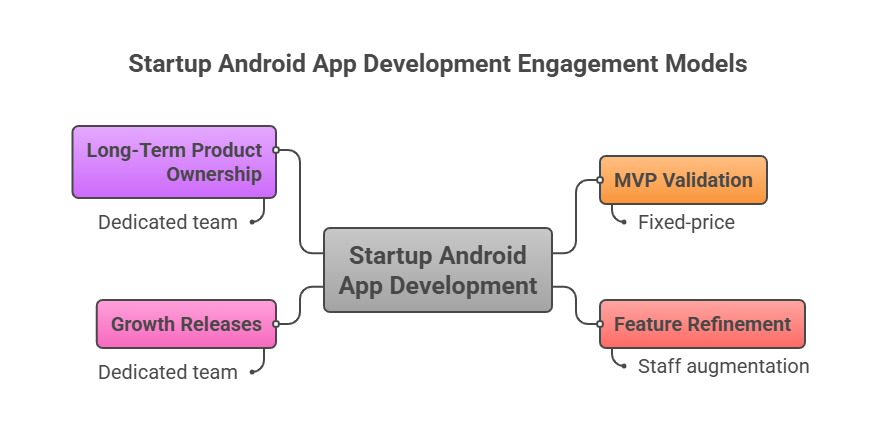
Early stage MVPs benefit most from staff augmentation or fixed price for defined modules, while growth-stage Android builds align better with dedicated teams that can evolve the product over multiple releases.
- Seed–Pre-Series A: Staff augmentation or targeted fixed-price makes sense, like rapid validation with controlled scope.
- Series A–B: Dedicated teams shine, like product direction becomes clearer, but flexibility is still essential.
- Series C–D / Scale: Mature dedicated teams with hybrid augmentation work best as products support multiple lines and scale concerns.
Practically, startups evolve from flexible, short contracts to semi-permanent team extensions as product complexity and user scale grow. The flow usually looks like:
When engagement models fail startups
Engagement models fail when they are chosen on price alone or when internal governance and technical ownership aren’t aligned with the model’s demands.
Primary failure triggers:
- Using fixed-price for evolving or poorly defined scope
- Staff augmentation without strong internal technical leadership
- Dedicated teams without clear collaboration workflows
- No governance on knowledge transfer, SLAs, or escalation paths
These failures are operational evidence, not vendor myths, and they cost startups both budget overruns and delayed releases.
How to Scale Android Development Teams as Your Startup Grows
Answer (1st line): You scale Android development effectively only when your architecture, engagement model, and team structure are designed to handle growth without exponentially increasing cost or slowing delivery velocity.
40% of software teams reported that poor architectural decisions made scaling significantly harder, with modular design and clean separations cited as key differentiators between teams that scaled well and teams that stalled.
This section cuts straight to how to design for scale, avoid vendor lock-in, and identify real team scalability signals.
MVP-to-scale Android architecture considerations
The architecture that gets an MVP shipped almost never scales, unless it’s built with modularization, clean boundaries, and testable layers from the start.
As you grow:
- Break features into modules with clear interfaces (feature modules, domain modules, UI modules)
- Separate business logic from UI and data layers
- Add CI/CD pipelines early to validate builds across modules
- Prioritize automated testing (unit + integration) so new features don’t break old ones
They directly determine velocity when hundreds of engineers and multiple teams work on the same codebase.
Avoiding vendor lock-in while scaling
Vendor lock-in kills scaling faster than architectural debt does. Many companies report scaling failures relevant to vendor dependency on proprietary codebases and toolchains as a primary barrier to internal team growth.
Risk box — avoid these:
- Vendor-only build pipelines
- Nonportable project structures
- Custom frameworks with hidden dependencies
- Lack of onboarding docs for new engineers
Indicators your team can scale with you
A team that can scale exhibits predictable delivery cycles, clear ownership boundaries, automated quality gates, and transparent metrics, not just velocity on feature checkboxes.
Checklist of real signals:
- Sprint metrics tied to quality (test coverage, defect rate)
- Clear ownership of modules and APIs
- CI/CD maturity (automated builds, test gates)
- Documentation that supports new engineers onboarding rapidly
- Low hand-off friction between design → dev → QA
Technical & Vendor Risks Founders Must Assess Before Signing
Founders must assess technical debt risks, security and compliance exposure, and handover/long-term maintainability upfront because these risks are the top causes of costly rework, breaches, or vendor lock-in after launch.
According to recent mobile industry security research, over 75% of apps contain at least one vulnerability. This risk is amplified when development oversight or compliance controls are weak.
Here, we break down the highest-impact risk vectors you must consider before committing to an Android partner.
Android technical debt risks in early outsourcing
Outsourcing without standards around architecture, module boundaries, CI/CD, and quality gating creates technical debt that slows every future release.
In practice, most mobile teams discover technical debt during maintenance cycles, not initial delivery, because decisions such as monolithic code, lack of test automation, or undocumented build pipelines aren’t obvious in early demos.
Poor integration of third-party components and outdated SDKs also exacerbate hidden attack surfaces.
Technical debt checklist:
- Absence of modular separation (UI/domain/data)
- No enforced CI/CD pipelines
- Sparse automated test coverage
- Outdated third-party SDKs or analytics frameworks
Security, compliance, and data ownership risks
Security vulnerabilities and compliance gaps (GDPR, HIPAA, PCI) are among the leading root causes of mobile data breaches, especially in regulated domains.
Compliance risk box:
- Lack of encryption or secure storage for sensitive data
- Absence of role-based access and secure API practices
- No data residency or privacy policy alignment
- Failure to embed DevSecOps and automated compliance checks
Security isn’t an add-on. It’s a non-negotiable requirement for FinTech, Healthcare, and any startup with personal or financial data.
Exit, handover, and long-term maintainability
Without a formal handover plan, documentation, and maintainability standards, transitioning Android development from an outsource partner to an internal team can cost more than 3× typical retention costs.
Vendor lock-in and poor handover are well-documented outsourcing risks: once a partner delivers code without clear ownership transfer, teams struggle to modify, secure, or scale it independently.
Handover checklist:
- Full source code plus CI/CD credentials
- Architecture documentation (modules, APIs)
- Test suites and automated pipelines
- Onboarding sessions + knowledge transfer
- Clear SLAs for post-handover support
When End-to-End Android Product Development Makes Sense for Founders
End-to-end Android product development makes sense for founders when the scope, long-term roadmap, market urgency, and quality expectations demand a cohesive strategy that a fragmented or hybrid build cannot reliably deliver.
Outsourced mobile app development can reduce development costs by up to 60% while improving time-to-market by around 40%, compared with largely in-house builds without optimized processes.
This demonstrates why a full-stack partner can be a strategic choice, not just a vendor, especially when founders prioritize velocity and cohesion across UX, backend, and platform couplings.
Below is how to decide whether end-to-end Android development aligns with your startup’s goals and what ROI signals justify that choice.
Founders vs in-house vs hybrid teams
Founders choose end-to-end partners when internal teams can’t match the speed or depth of expertise required, in-house when tight product control and deep business context matter most, and hybrid teams when you need internal ownership plus plug-in experts for specific gaps.
In practice, outsourcing Android app development often delivers faster cycle times and broader talent access without the overhead of hiring full-time staff, while in-house work gives maximum control over product decisions. Hybrid teams combine both but only succeed if internal leadership can integrate external work effectively.
Comparison snapshot:
- Founders/outsourced: fast execution, strategic accelerator
- In-house: deep control, potential slower ramp
- Hybrid: best balance if governance is strong
ROI signals that justify end-to-end partners
Founders should choose an end-to-end Android partner when measurable ROI indicators, such as faster time to market, cost efficiency, and improved scalability, outpace what in-house or hybrid alternatives can deliver.
Founders see clear ROI when a partner drives end-to-end alignment, meaning design, development, testing, and post-launch maintenance are orchestrated as a single, optimized workflow.
That minimizes hand-offs, reduces context loss, and delivers predictable business impact.
How to Choose the Best Android App Development Partner for Startups
Use this checklist to evaluate Android development partners because a structured partner evaluation reduces risk, improves speed, and clarifies deliverables, a necessity when outsourcing contributes to more than $129.9 billion in mobile app development revenue globally by 2028.
This checklist condenses the most critical criteria founders and CTOs use in real vendor evaluations, not generic traits, but predictors of delivery performance and long-term product health.
Essential Partner Evaluation Checklist
Technical & Delivery Readiness
- Clear architectural standards (e.g., layered clean architecture, modularization), no ad-hoc code structures
- CI/CD pipelines and build automation in place from day one
- Automated test coverage metrics reported (unit + integration)
- Security practices embedded in dev lifecycle (DevSecOps checkpoints, OWASP standards)
Process & Communication
- Documentation & onboarding workflows ready before kickoff
- Sprint cadences tied to measurable outcomes, not hours
- Clear escalation paths and governance frameworks
Contract, Ownership & Compliance
- Full code/IP ownership clauses confirmed in writing
- Data handling and compliance alignment (GDPR, HIPAA, etc.)
- Post-launch support terms defined (SLA, maintenance windows)
Business Fit & Risk Alignment
- References from startups of similar scale
- Transparent cost structure with hidden cost disclosure
- Risk mitigation plan tied to milestones (risk matrix + response plans)
Unsure if your Android project is being scoped the right way?
Get a technical and engagement-model review focused on scalability, ownership, and long-term cost. A 30-minute review now can save months of refactoring later
Wrapping it Up
Choosing the best Android app development partner for a startup is ultimately about preserving optionality.
At early stages, startups fail because early technical and delivery decisions silently limit their ability to adapt. Architecture that can’t scale, engagement models that resist change, and partners that retain too much control all turn growth into friction.
The startups that scale well treat Android development as a foundational system, not a one-off build. They invest just enough structure early to protect speed later. They choose partners who understand uncertainty, design for change, and plan for eventual handover from day one.
If there’s one takeaway, it’s this:
The right Android partner reduces future constraints. The wrong one becomes the biggest constraint.
In This Article
Frequently Asked Questions
In 2026, a realistic budget for outsourcing Android development is around $50k–$120k for a scalable MVP and $120k–$250k+ for a production-ready V1. Lower budgets usually cover demo-level builds that require refactoring once real users and integrations come in.
When requirements evolve after MVP, dedicated teams or staff augmentation are safer than fixed-price contracts. They allow scope changes without constant renegotiation, which is critical once real user feedback starts shaping the roadmap.
A partner can scale with you if their codebase, testing, and delivery processes already support growth. If adding new engineers slows things down instead of speeding them up, the team isn’t built to scale.
Early decisions around modular architecture, clean separation of logic, and automated testing matter far more than framework choices. Most expensive rewrites happen because MVP code wasn’t designed to tolerate change.
Startups protect ownership by ensuring full access to repositories, CI/CD pipelines, documentation, and build systems from day one. Legal ownership alone doesn’t prevent vendor lock-in if operational control is missing.
End-to-end Android development makes sense when speed, coordination, and execution quality matter more than short-term internal ownership. It’s most effective before a startup has the time or structure to build a senior Android team internally.
Blocked by Backlog or Missed Deadlines?
Senior developers who build, fix, and ship, without slowing your team down.